
Language
Views: 269 Author: 7DaysVape Publish Time: 2026-10-01 Origin: Site


Content Menu
● Ingot 9000 vs IGET Bar Plus S3: Specifications
>> What the puff ratings cannot tell you
● Which Device Fits Remote Camping?
>> No charging access: Ingot is simpler
>> Reliable power available: S3 is more flexible
>> The answer for an Australian trip
>> Estimate demand before packing
>> Run a pre-trip failure check
>> Charging and storage outdoors
>> Compare full-trip cost, not shelf price
>> Health and campsite etiquette
● Verdict and Frequently Asked Questions
>> 1. Will either device definitely last seven days?
>> 2. Is the IGET Bar Plus S3 Pod a complete vape?
>> 3. Can I recharge the Ingot 9000?
>> 4. Does the S3's 10,000-puff rating mean one charge lasts 10,000 puffs?
>> 5. Which creates less battery-containing waste?
>> 6. Can I buy these products online for an Australian camping trip?
>> 7. What if I cannot safely charge during the trip?
For a week-long remote camping trip, the Ingot 9000 vs IGET Bar Plus S3 Pod decision comes down to one practical question: will you have a reliable way to recharge? The Ingot 9000 is a sealed, non-rechargeable disposable. The S3 is a replaceable-pod system with a rechargeable device. Neither advertised puff count guarantees seven days of use, and for campers in Australia, neither product should be treated as a straightforward retail purchase: national rules restrict vape supply to pharmacies for smoking cessation or nicotine-dependence management. [alibarbar]
This guide compares the published hardware specifications, then tests what those numbers mean for power planning, packing, waste and legal access. It is a specifications-based assessment, not a claim that either device was field-tested on a camping trip.

The distinction matters before any numbers do: an S3 pod is not a complete device. It needs a compatible IGET Bar Plus battery unit. IGET publishes specifications for the S3 kit, device and replacement pod separately. Ingot specifications below come from a product listing; its official brand page confirms the model's disposable format but provides fewer technical details. [alibarbar]
| Camping consideration | ALIBARBAR Ingot 9000 | IGET Bar Plus S3 system |
|---|---|---|
| Format | Sealed disposable | Rechargeable device with replaceable pods |
| Advertised puff rating | Up to 9,000 per device | Up to 10,000 per S3 pod |
| Battery | Listed as 2,350 mAh; non-rechargeable | 950 mAh; rechargeable via USB-C |
| E-liquid volume | Listed as 22 mL | Not specified on IGET's S3 pages reviewed here |
| Weight | Listed as approximately 90 g | 100.6 g for the assembled kit; 44.7 g for a replacement pod |
| Charging gear | None for normal use | Charging cable and a suitable power source |
| When the liquid runs out | Replace the entire device | Replace the pod and keep the device |
| Main remote-trip risk | If its sealed battery stops working, it cannot be recharged | If charging power is unavailable, spare pods do not solve a flat battery |
The published puff ratings are "up to" figures, not measured camping endurance. IGET states that the S3 kit has a 950 mAh battery, USB-C charging, a 1.0 Ω mesh coil and a 100.6 g assembled weight. Its replacement-pod page lists a 44.7 g pod and compatibility within the IGET Bar Plus series. An Ingot retailer lists 22 mL, 2,350 mAh, approximately 90 g and a non-rechargeable design. Check the exact packaging and seller documentation before relying on those Ingot figures. [igetvape]
A 10,000-puff label does not prove that the S3 will last longer than an Ingot 9000 in your hands. Draw duration, frequency and whether the device remains usable until its liquid is depleted all affect the result. Neither rating is a promise of a fixed number of days.
The same caution applies to battery capacity. 2,350 mAh versus 950 mAh is not a direct runtime comparison between differently designed products. The Ingot's battery is intended to serve one sealed device; the S3 battery is recharged and reused with replacement pods. The useful camping question is not simply "Which number is bigger?" It is "What happens if power or liquid runs out before I return?"
If your campsite has no dependable charging source, the Ingot removes a step from your routine. There is no cable to protect from rain, no power bank to allocate, and no need to reserve a charging window. You can check its battery and liquid indicators before departure and during the trip, according to the product descriptions. [alibarbar]
That convenience comes with a hard limit: you cannot recharge it. A sealed device may be unsuitable as a sole supply if it is already partly used or if its battery fails before the liquid is finished. Its high advertised capacity makes it a candidate for an off-grid trip, not a guarantee of uninterrupted use.
For a short, weight-conscious trip, carrying one approximately 90 g unit may look appealing beside an assembled S3 kit at 100.6 g. But the comparison changes if you need redundancy. A second Ingot means carrying a second complete battery-containing device. With the S3, an additional pod weighs less than another assembled kit, although a spare pod cannot replace a flat or faulty battery unit. [igetvape]
The S3 becomes more useful when your itinerary includes dependable charging. Its USB-C device can be reused, and its pods can be changed without discarding the battery unit each time. IGET says the S3 replacement pod works across devices in the Bar Plus series, but you should still confirm the exact device-and-pod pairing printed on the products you have. [igetvape]
For camping, flexibility is the S3's strongest argument. If a pod runs out while the battery still works, you can replace the pod. If the battery runs low while the pod still contains liquid, you can charge the device. Those are two separate problems with two separate solutions—provided you actually have a safe, working source of power.
Do not mistake "rechargeable" for "maintenance-free." A power bank needs charge; a cable can be forgotten; and a damp or damaged charging port can interrupt the plan. If charging is uncertain, the S3's larger advertised puff rating offers little reassurance on its own.
For a camping trip in Australia, legal access comes before product preference. Australian Government guidance says all vapes, with or without nicotine, can be sold only through pharmacies for smoking cessation or nicotine-dependence management. Single-use disposable vapes cannot be purchased in a pharmacy, and other retailers cannot legally sell vaping products. Eligible adults may access certain lower-strength therapeutic vapes from participating pharmacies without a prescription where state or territory rules permit; a pharmacist consultation is required. [health.gov]
Australia's strengthened therapeutic-vape standards also set a 5 mL maximum for vaping-substance accessories, including pods, for products lawfully supplied under that framework from July 2025. The Ingot listing's 22 mL capacity is well above that limit for an accessory, and the Ingot is described as disposable. IGET's S3 pages reviewed here do not state its pod's liquid volume, so do not assume the marketed S3 pod is an Australian-compliant therapeutic product. [igetvape]
The regulator's notified list is a tool for checking specific therapeutic goods, but inclusion alone does not mean a product has been independently approved for safety or performance. It also does not guarantee pharmacy availability. Do not confuse a differently named IGET Bar Plus product on a list with the exact S3 device or pod in this comparison. [tga.gov]

The most useful comparison is based on your own consumption, not a puff-count contest. The following method is a planning framework, not a laboratory endurance test.
1. Record your normal use. Over several ordinary days, note how long a device or pod lasts for you. Include a day with the kind of activity you expect while camping.
2. Convert that pattern to seven days. If one pod normally lasts three days, one pod is not a sensible seven-day plan—even if its packaging advertises thousands of puffs.
3. Separate liquid from power. For the S3, estimate replacement pods and charging opportunities independently. More pods cannot power an empty battery.
4. Check the starting condition. A partly used Ingot or S3 pod has less margin than a fresh one. A device that appears functional at home may still fail outdoors.
5. Plan for disruption. Weather, a missed charging stop or a damaged item can change the calculation. Do not make nicotine access more important than water, food, navigation or emergency communications.
Here is an illustration, not a performance claim: suppose your own records show that an S3 pod lasts about four days. On that pattern, one pod does not cover a seven-day trip, regardless of its advertised 10,000-puff ceiling. You would also need to establish that the 950 mAh device can be recharged when required. If your Ingot typically lasts longer than seven days, its no-charge design may be simpler—but a previous trip, not its "9,000" label, is the stronger basis for that decision. [igetvape]
A five-minute check can reveal more than another comparison of marketing claims:
- Confirm the exact model, pod compatibility and instructions on the packaging.
- Inspect the device and pod for damage or leakage; do not use damaged equipment.
- For an S3, confirm that the device charges using compatible equipment and that your intended power source works.
- For an Ingot, remember that a low or failed battery cannot be recovered by charging.
- Check the destination's vaping restrictions, including campsite and park rules.
- Decide how you will bring used pods or devices back for appropriate disposal.
This process is deliberately conservative. It avoids claiming that either device is waterproof, dustproof or suitable for charging inside a tent; the manufacturer pages reviewed here do not establish those protections. It also keeps the decision focused on a camper's real failure points rather than on the largest printed number.
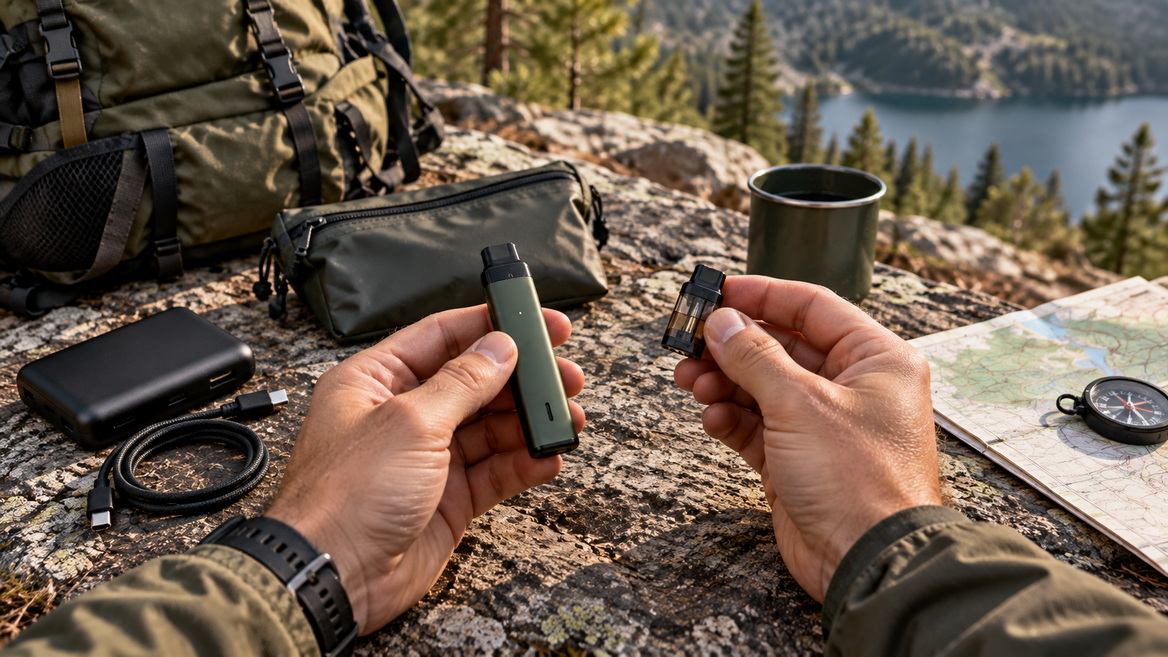
Both products contain batteries. Do not leave either device in a hot vehicle or direct sun, and do not use one that shows damage, swelling, unusual heat or leakage. For the rechargeable S3, use compatible charging equipment, keep it on a firm surface and unplug it when charging is complete. Do not charge on a sleeping bag or leave it charging unattended in a tent. The U.S. National Park Service's lithium-ion battery guidance specifically warns against hot cars, soft charging surfaces and unattended charging. [nps]
Rain protection needs care too. Keep the S3, spare pods and cable dry, and inspect the charging port before connecting power. If equipment is wet or visibly damaged, do not try to charge it. Follow the device instructions rather than improvising a repair or attempting to open a sealed Ingot. [nps]
Dispose of neither device nor loose batteries in ordinary campsite rubbish. The Ingot leaves a complete battery-containing unit when finished; the S3 allows you to retain the battery device while replacing pods. That is a meaningful difference in *what* you carry out, but it does not justify a claim that either option is environmentally harmless. Take used items home and use an appropriate local collection route. [igetvape]
Without verified, location-specific prices for both products, declaring a universal cost winner would be misleading. Instead, calculate what your trip actually requires:
- Ingot trip cost: the number of complete devices needed at your observed rate of use.
- S3 first-trip cost: a compatible device, enough pods and any charging equipment you do not already own.
- Later S3 trip cost: replacement pods, assuming the original device remains usable.
The S3's reusable device may make more sense across repeated trips, while the Ingot avoids an upfront charging setup. Neither conclusion follows automatically from the advertised puff counts. Confirm that any purchase and supply method is lawful at your destination before comparing checkout totals.
A high-capacity vape is still a nicotine or aerosol product, not essential camping equipment. Australian health guidance says vaping is not safe and advises people seeking help with smoking or nicotine dependence to speak with a health professional. Healthdirect describes assessed nicotine-replacement medicines and professional support as options for quitting. Non-users should not start vaping for a trip. [health.gov]
Respect people sharing a campsite, vehicle or shelter. Before leaving, check the park's rules rather than assuming that an outdoor location permits vaping. Australian Government guidance says vaping is generally prohibited where tobacco smoking is banned, although the specific rules can vary by state or territory. [health.gov]
Best fit without charging, where lawfully available: the Ingot 9000 is the simpler hardware choice because it requires no recharge. Best fit with dependable charging, where lawfully available: the IGET Bar Plus S3 offers replaceable pods and a reusable battery device. Neither is a proven seven-day winner from specifications alone. For an Australian camping trip, do not use this comparison as a shopping recommendation for either marketed product; ask a participating pharmacist about lawful options and your circumstances instead. [igetvape]
7DaysVape readers outside Australia should check local age, product and supply rules before making any decision. If you already use a vape and are preparing for a trip, compare your recorded consumption against your power plan—then verify the exact device and pod documentation. That is more useful than choosing by "9,000" or "10,000" alone.
No. Both puff figures are advertised upper limits, not verified seven-day endurance ratings. Your own use pattern and, for the S3, access to charging determine whether a setup is adequate. [igetvape]
No. The replacement pod is one part of the system; it requires a compatible Bar Plus battery device. IGET publishes separate pages for the pod and rechargeable device. [igetvape]
The Ingot 9000 product listing reviewed here describes it as non-rechargeable. Do not try to modify or charge a sealed unit on the assumption that another product in the Ingot range works the same way. [alibarbaroz]
No. The rating describes the marketed pod experience, while the S3 device has a 950 mAh rechargeable battery. Its ability to recharge is part of how the system can continue to use a pod; the rating is not a one-charge guarantee. [igetvape]
Replacing an S3 pod lets you keep using its battery device. Finishing an Ingot means dealing with the entire battery-containing disposable. That describes the product formats; it is not a quantified environmental-impact study. Dispose of used equipment through an appropriate local route. [igetvape]
Do not assume so. Australian guidance restricts vape sales to pharmacies for therapeutic purposes and says other businesses cannot legally sell them. Verify the exact product and your eligibility with a participating pharmacist rather than relying on an online listing or delivery claim. [health.gov]
Treat the S3 as a device with limited remaining battery until you reach a suitable charging point. Extra pods do not solve that problem. If maintaining nicotine-dependence treatment during travel is a concern, discuss a lawful, practical plan with a pharmacist or clinician before departure. [health.gov]
1. Australian Government Department of Health, Disability and Ageing. "[About vaping and e-cigarettes]." Australian supply rules, health information and restrictions. [health.gov]
2. Therapeutic Goods Administration. "[Product standards: unapproved therapeutic vapes]." Strengthened product standards and accessory-volume limit. [tga.gov]
3. Therapeutic Goods Administration. "[Notified vape list: goods for smoking cessation or nicotine dependence]." Product-notification scope and limitations. [tga.gov]
4. IGET Vape. "[IGET BAR PLUS S3]." Published assembled-kit specifications. [igetvape]
5. IGET Vape. "[IGET BAR PLUS S3 POD]." Published pod specifications and Bar Plus compatibility claim. [igetvape]
6. IGET Vape. "[IGET BAR PLUS S3 Device]." Battery-unit weight and charging specifications. [igetvape]
7. ALIBARBAR. "[INGOT 9000]." Official model description. [alibarbar]
8. ALIBARBAR OZ. "[Alibarbar Ingot 9000 Disposable Vape]." Retailer-listed capacity, battery, weight and non-rechargeable format; verify against actual packaging. [alibarbaroz]
9. U.S. National Park Service. "[I Didn't Know That!: Lithium-Ion Battery Safety]." Charging, heat and disposal precautions. [nps]
10. Healthdirect Australia. "[Quitting smoking and vaping]." Health and quitting-support information. [healthdirect.gov]
This website contains products intended for adults only.
Are you 18 years of age or older?
WARNING: This product contains nicotine. Nicotine is an addictive chemical.


