
Language
Views: 236 Author: 7DaysVape Publish Time: 2026-11-12 Origin: Site


Content Menu
● Hookah Bong vs IGET Bar 3500: What Is Being Compared?
>> Understanding the hookah side of the comparison
>> Understanding the electronic-cigarette side
● Hookah vs Electronic Cigarettes: A Practical Comparison
● Health Considerations: Different Emissions, Not a Safety Contest
>> Hookah water does not remove the underlying risk
>> Vape aerosol is not harmless water vapour
>> Why a simple "safer" verdict is inadequate
● Outdoor Gatherings: Why Open Air Is Not the Whole Answer
>> Consider everyone sharing the venue
>> Do not invent a universal safe distance
● Social Dynamics: Participation Should Never Be Assumed
>> A shared activity can create unspoken pressure
>> Smaller devices do not remove shared-space responsibilities
● Australian Vaping Rules: The Essential Distinction
>> Retail availability does not establish lawful supply
>> Pharmacy access has conditions
>> Supply rules and use restrictions are separate
● Environmental Impact: Include the After-Event Work
>> Disposable electronic devices create a waste-management problem
>> Avoid unsupported environmental rankings
● A Five-Step Checklist for Responsible Event Planning
● Evidence Check: What Puff Counts and Research Cannot Tell You
>> A puff count is not an exposure measurement
>> Indoor research cannot predict every outdoor event
● Conclusion: Plan Around Guests, Not Products
>> Is a hookah bong the same as an electronic cigarette?
>> Does hookah water make the smoke safe?
>> Is vaping outdoors harmless to nearby guests?
>> Can an Australian online retailer legally sell disposable vapes?
>> Can disposable vapes go into ordinary recycling bins?
>> Which option is better for a large outdoor gathering?
A Hookah Bong vs IGET Bar 3500 comparison for large outdoor gatherings should begin with the people sharing the space—not with flavours, clouds, or advertised puff counts. These products raise different questions about smoke, aerosol, other guests' exposure, waste, and legal responsibilities. Neither should be treated as a harmless party accessory. [cdc]
For Australian readers, there is another essential distinction: retail availability overseas does not establish lawful supply in Australia. Australian rules restrict vape sales to the pharmacy framework, and single-use disposable vapes cannot be purchased through that framework. [health.gov]
This article takes an evidence-based event-planning perspective. It does not report hands-on testing of the IGET Bar 3500 or claim that one product creates a better social experience. Instead, it explains the differences that matter when protecting guests and managing a shared outdoor environment.

"Hookah bong" is an imprecise expression. Here, hookah means a traditional waterpipe used with shisha tobacco, typically heated using charcoal. The conclusions below concern that arrangement, not every waterpipe or every substance that might be used in one.
A hookah draws smoke through water before the user inhales it. However, water does not make the smoke safe: harmful substances remain after it passes through the water. Charcoal also contributes pollutants, including carbon monoxide. [cdc]
Electronic cigarettes use a battery to heat liquid and create an aerosol. Unlike a traditional charcoal-heated hookah, they do not require burning charcoal. However, their emissions are not simply harmless water vapour. Bystanders can inhale aerosol exhaled by users. [cdc]
The IGET Bar 3500 name is used here as the product named in the comparison. No independently verified testing of its contents, emissions, nicotine concentration, or advertised capacity was established for this article. Consequently, category-level evidence about electronic cigarettes should not be mistaken for laboratory findings about this particular model.
| Consideration | Traditional charcoal-heated hookah | Electronic cigarette named in the comparison |
|---|---|---|
| Operating principle | Tobacco is heated using charcoal; smoke passes through water. | A battery heats liquid to produce aerosol. |
| Airborne exposure | Includes tobacco smoke and emissions from the heat source. | Includes exhaled aerosol that may contain harmful substances. |
| Distinctive concern | Charcoal contributes carbon monoxide and other pollutants. | Aerosol composition and battery-containing waste require attention. |
| Evidence limitation | Exposure varies with the equipment, material, and session. | General vaping evidence does not establish this model's exact emissions. |
| Australian supply question | Separate tobacco and venue rules require checking. | Vape sales are restricted to the pharmacy framework; single-use disposables are excluded. |
| Planning priority | Prevent involuntary smoke exposure and comply with applicable restrictions. | Prevent involuntary aerosol exposure and comply with applicable restrictions. |
These distinctions follow public-health guidance on hookahs, electronic cigarettes, Australian supply rules, and vape disposal. They are not a ranking of purchasing value or suitability for parties. [cdc]
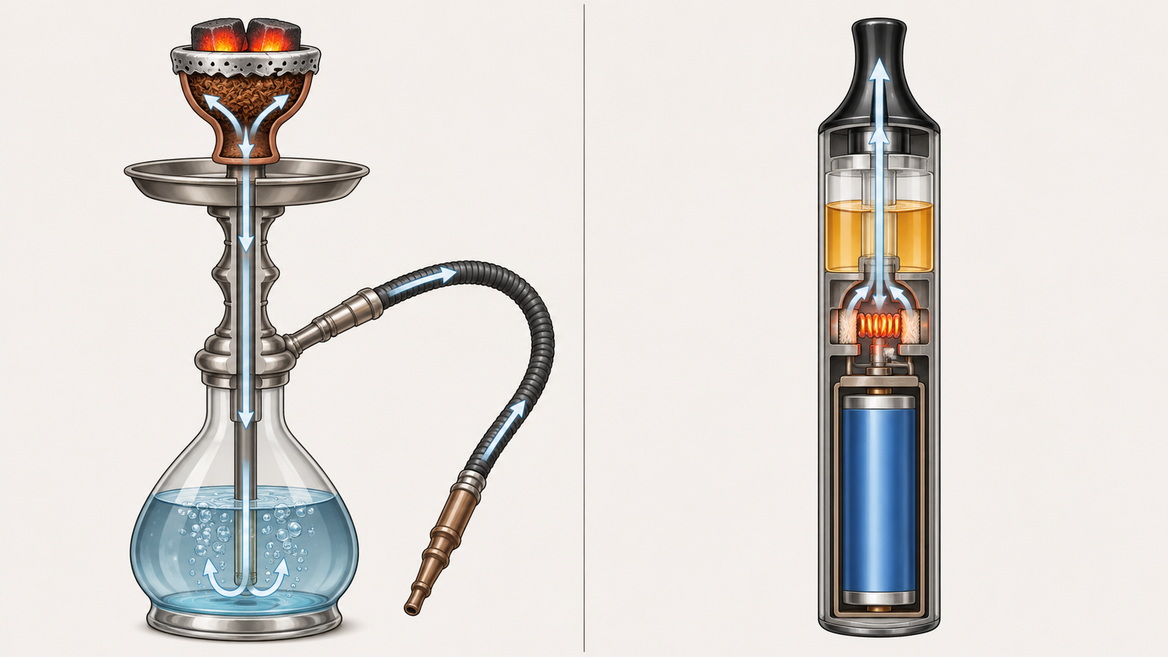
The water chamber can create a misleading impression of filtration. The relevant question is not whether smoke passes through water, but what remains in the smoke afterward.
The US Centers for Disease Control and Prevention identifies nicotine, tar, and heavy metals among harmful components of hookah smoke. It also notes that charcoal can produce substantial carbon monoxide, metals, and cancer-causing chemicals. These hazards affect both users and people exposed to the smoke. [cdc]
For an organiser, that means hookah smoke cannot be treated as a purely personal choice once it enters a shared space.
Electronic-cigarette aerosol can contain nicotine, tiny particles, volatile organic compounds, heavy metals, and cancer-causing chemicals. The presence and amounts of particular substances vary; a general list does not prove that every product contains every substance at the same concentration. [cdc]
This distinction matters when discussing an individual model. Without reliable product-specific analysis, statements such as "clean aerosol," "safe ingredients," or "harmless to nearby guests" are not justified.
Removing charcoal changes the exposure profile, but it does not establish that an electronic cigarette is harmless. Likewise, identifying hazards from vaping does not mean its emissions are identical to hookah smoke.
A useful comparison keeps the categories separate. For event planning, the actionable conclusion is narrower: neither product warrants exposing unwilling guests to smoke or aerosol. [cdc]
An outdoor setting should not be treated as a blanket exemption from exposure concerns or venue restrictions.
Guests may stand close together, gather near entrances, or spend time beneath partially enclosed structures. An event organiser should therefore assess how people actually occupy the space rather than relying only on the word "outdoor."
An inclusive plan should account for:
- Guests who do not smoke or vape.
- Children and young people.
- People who have asked to avoid smoke or aerosol.
- Staff who cannot easily leave their workstations.
- Guests with breathing problems.
Australian health guidance identifies children and people with breathing problems among those especially vulnerable to secondhand tobacco smoke. It also recognises that people near someone vaping can inhale secondhand aerosol. [health.gov]
The sources used here do not establish one distance that guarantees safety for every outdoor gathering. A precise number would create false confidence.
Instead, check the applicable legal boundaries and venue policy. Where the aim is to prevent exposure across the event, a clearly communicated smoke-free and vape-free policy provides a more consistent planning approach than informal requests made after problems arise.
Published research describes hookah use as a social activity, often involving shared equipment. That social setting is relevant, but it does not prove that hookah improves a gathering or that everyone welcomes its presence. [stacks.cdc]
From an organiser's perspective, the important question is whether guests can participate fully without being expected to smoke, vape, or remain near emissions.
A useful planning principle is simple: make the gathering's main activities independent of nicotine or tobacco use.
An electronic cigarette does not need a fixed hookah station, but its emissions still enter the surrounding air. Personal ownership should not be confused with an absence of consequences for others. [cdc]
Avoid creating a rule that focuses only on large, visible equipment while ignoring electronic cigarettes. A clearly written policy should name both smoking and vaping so guests do not have to guess what is permitted.
Australian Government guidance states that vapes and vaping products, whether or not they contain nicotine, can only be sold in pharmacies for smoking cessation or management of nicotine dependence. Other businesses cannot legally sell these products. Single-use disposable vapes cannot be purchased in pharmacies. [health.gov]
This is particularly important when evaluating an overseas website or product listing. A listing is not evidence that a product can lawfully be supplied to Australian consumers.
Adults aged 18 and over may access certain therapeutic vapes containing no more than 20 mg/mL nicotine from participating pharmacies without a prescription, subject to conditions and state or territory law. A pharmacist consultation is required; higher concentrations require a prescription. [health.gov]
These provisions should not be presented as general permission to purchase recreational disposable vapes.
A product's supply status does not answer where someone may use it. Australian guidance states that vaping is generally prohibited where smoking is banned, while specific smoke-free rules vary by jurisdiction. [health.gov]
Check the relevant state or territory requirements and the venue's own conditions before publishing an event policy.
Vapes can combine plastics, electronic components, chemicals, and lithium-ion batteries. Australian Government guidance classifies them as electronic waste and warns against placing them in kerbside bins because of fire risks. Disposal arrangements vary by location. [health.gov]
For an organiser, the practical issue is not simply how much litter appears on the ground. It is whether discarded devices can enter ordinary rubbish or recycling streams.
A reusable hookah and a disposable electronic cigarette have different material and waste profiles. However, this article does not have a lifecycle assessment supporting a precise comparison of their total environmental footprints.
Claims such as "greener," "sustainable," or "lower carbon" would therefore go beyond the evidence reviewed.
A more defensible approach is to identify the actual waste involved, consult local disposal guidance, and avoid making environmental claims based solely on whether a product is reusable or disposable.
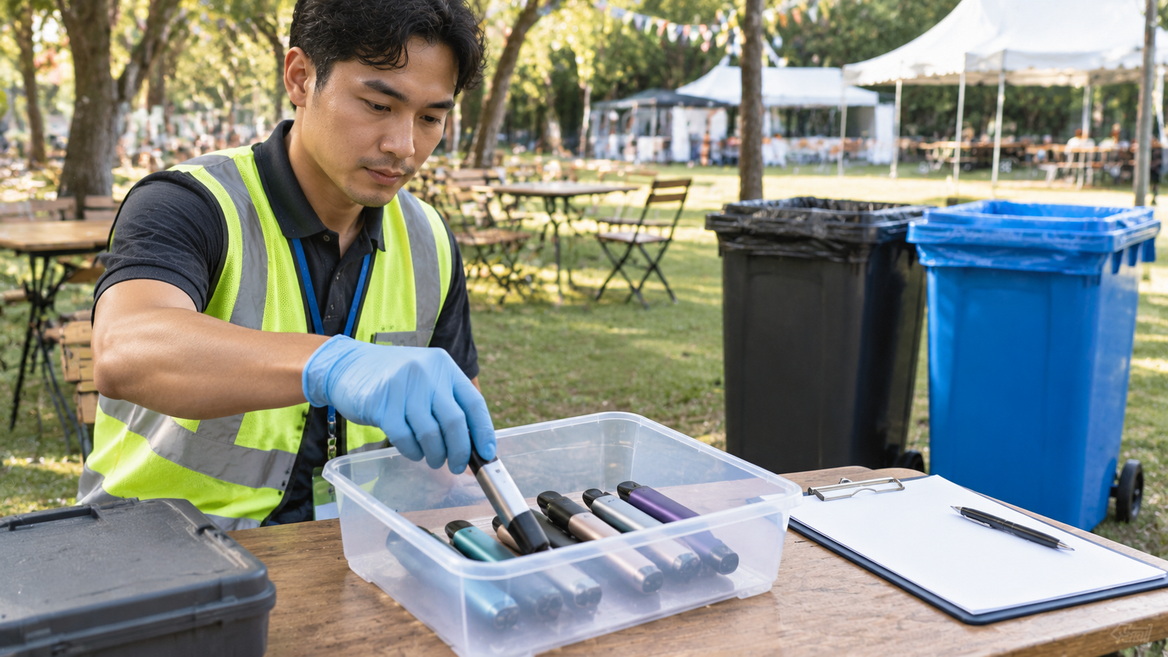
The following is an editorial planning framework, not a regulatory standard or a tested guarantee of safety.
1. Check the rules before finalising the invitation. Review the venue contract, applicable smoking and vaping restrictions, and any relevant site conditions.
2. Write one clear policy. State whether smoking and vaping are prohibited. Avoid vague wording such as "please be considerate" without explaining expectations.
3. Protect shared activities. Keep attendance, seating, entertainment, and conversation independent of smoking or vaping.
4. Brief staff consistently. Give staff the same wording so enforcement does not depend on individual preferences.
5. Confirm waste arrangements. Ask the venue or local council how any abandoned electronic-cigarette devices should be handled. Do not direct them into kerbside bins. [health.gov]
For a large gathering, clarity before arrival is preferable to negotiating boundaries after guests have settled in.
The number in a product name does not establish nicotine intake, emissions, or a safe amount of use. This article has not independently verified the advertised capacity of the IGET Bar 3500.
A puff-count claim also cannot be meaningfully compared with a hookah session unless the measurement methods and conditions are defined.
Research on hookah venues has identified elevated particulate matter and carbon monoxide, including occupational exposure concerns for workers. Those findings help identify hazards, but indoor measurements should not be presented as forecasts for a particular outdoor party. [stacks.cdc]
This is the central evidence boundary: recognising a hazard is different from calculating an individual guest's dose or long-term risk.
The most useful Hookah Bong vs IGET Bar 3500 comparison is not a contest over social appeal. It is an assessment of different emissions, evidence limitations, legal responsibilities, and waste-management needs.
Before hosting, confirm the venue's rules, publish a clear smoking and vaping policy, and verify local disposal guidance. For personal questions about nicotine dependence or stopping smoking, consult a qualified healthcare professional rather than relying on product marketing.
No. In this article, hookah means a charcoal-heated tobacco waterpipe. An electronic cigarette heats liquid using a battery. Their operating mechanisms and emissions differ. [cdc]
No. Harmful substances remain after smoke passes through the water. Charcoal also contributes pollutants, including carbon monoxide. [cdc]
No such assurance is justified. Bystanders can inhale exhaled aerosol, and electronic-cigarette aerosol can contain harmful substances. [cdc]
Australian guidance restricts vape sales to pharmacies within the therapeutic framework. Single-use disposable vapes cannot be purchased through pharmacies. [health.gov]
They should not go into kerbside bins. Their batteries create fire risks, and local designated disposal arrangements should be checked. [health.gov]
This evidence does not establish either as a recommended party feature. A responsible event policy prioritises lawful operation, voluntary participation, and preventing unwanted smoke or aerosol exposure.
- US Centers for Disease Control and Prevention. "Hookahs." Public-health guidance covering smoke, charcoal emissions, water filtration, and secondhand exposure. [cdc]
- US Centers for Disease Control and Prevention. "About E-Cigarettes (Vapes)." Guidance covering device operation, aerosol constituents, and bystander exposure. [cdc]
- Australian Government Department of Health. "About Vaping and E-Cigarettes." Guidance covering pharmacy-only sales, disposable products, and use restrictions. [health.gov]
- Australian Government Department of Health. "Vaping Laws." Guidance covering therapeutic access, pharmacist consultation, and jurisdictional conditions. [health.gov]
- Australian Government Department of Health. "Going Vape-Free." Guidance covering electronic waste, batteries, and disposal. [health.gov]
- Australian Government Department of Health. "Passive Smoking." Guidance covering secondhand tobacco smoke and vulnerable populations. [health.gov]
- Al-Faham and colleagues. "Tobacco and Other Occupational Exposures Among Hookah Bar Workers." Research discussing workplace exposure; available through the CDC repository. [stacks.cdc]
This website contains products intended for adults only.
Are you 18 years of age or older?
WARNING: This product contains nicotine. Nicotine is an addictive chemical.


