
Language
Views: 226 Author: 7DaysVape Publish Time: 2026-11-18 Origin: Site


Content Menu
● Fruit Nicotine Gum vs Nicotine Pouch: Key Differences
● Why Continuous Nicotine Gum Chewing Can Cause Problems
>> Nicotine Gum Works Differently From Ordinary Gum
>> Not Every Aching Jaw Is a Gum Problem
● Fruit Nicotine Gum: Benefits and Limitations
>> Where Gum May Be Unsuitable
● Nicotine Pouches: Less Chewing, Different Risks
>> A Stationary Product Is Not a Jaw Treatment
>> Craving Relief Does Not Prove Long-Term Quitting Success
● How to Use Nicotine Gum Without Continuous Chewing
>> Step 2: Chew Slowly, Then Park
>> Step 3: Repeat Intermittently
>> Step 4: Watch Food and Drink Timing
>> Step 5: Review Persistent Discomfort
● A Better Decision Framework: Separate Three Problems
>> 2. The Urge to Keep Your Mouth Busy
● A Practical Symptom Record Before Your Appointment
● Approved Alternatives That Reduce Jaw Work
● Australian Rules Change the Comparison
>> Is Fruit Nicotine Gum Gentler on the Jaw Than Mint Gum?
>> Can Nicotine Pouches Cure Jaw Fatigue?
>> Should I Chew Nicotine Gum Until the Flavour Disappears?
>> Are Nicotine Gum and Pouch Strengths Directly Comparable?
>> What Can I Use if Nicotine Gum Makes My Jaw Ache?
>> Can Australians Import Nicotine Pouches With a Prescription?
Comparing fruit nicotine gum vs nicotine pouch products can seem straightforward when your jaw aches: one involves chewing, while the other does not. However, less chewing does not automatically mean a safer product or a better way to stay smoke-free. For former smokers, the most useful comparison considers jaw movement, nicotine delivery, oral irritation, treatment evidence, and local regulations.
The practical starting point is simple: nicotine gum should not be chewed continuously like ordinary gum. Correcting your technique may reduce unnecessary jaw work. If discomfort continues, an approved nicotine patch or lozenge may be more appropriate than switching to a nicotine pouch.
This guide examines the differences without treating either product as a cure for jaw pain.
 Fruit Nicotine Gum vs Nicotine Pouch: Key Differences
Fruit nicotine gum is a flavoured form of nicotine replacement therapy when supplied as an approved medicinal product. Nicotine pouches are small sachets placed between the lip and gum. Although both deliver nicotine through the mouth, they are not interchangeable.
| Comparison point | Approved fruit nicotine gum | Nicotine pouch |
|---|---|---|
| How it is used | Intermittent chewing followed by parking against the cheek | Held between the lip and gum |
| Jaw movement | Some movement; continuous chewing is unnecessary | Does not require chewing |
| Main concern for sore jaws | Repeated chewing may contribute to discomfort | Avoids chewing but can irritate oral tissues |
| Smoking-cessation status | Established nicotine replacement option | Not an FDA-approved smoking-cessation aid |
| Nicotine strength | Common medicinal strengths include 2 mg and 4 mg | Strength and delivery vary across products |
| Long-term evidence | Established role in smoking cessation | Long-term health effects remain uncertain |
| Australian consumer access | Approved products remain available | Consumer purchase and import pathways closed from 24 July 2026 |
For someone with jaw fatigue, the important distinction is between removing a mechanical trigger and selecting an appropriate treatment. A pouch may remove chewing, but that alone does not make it the best clinical choice.
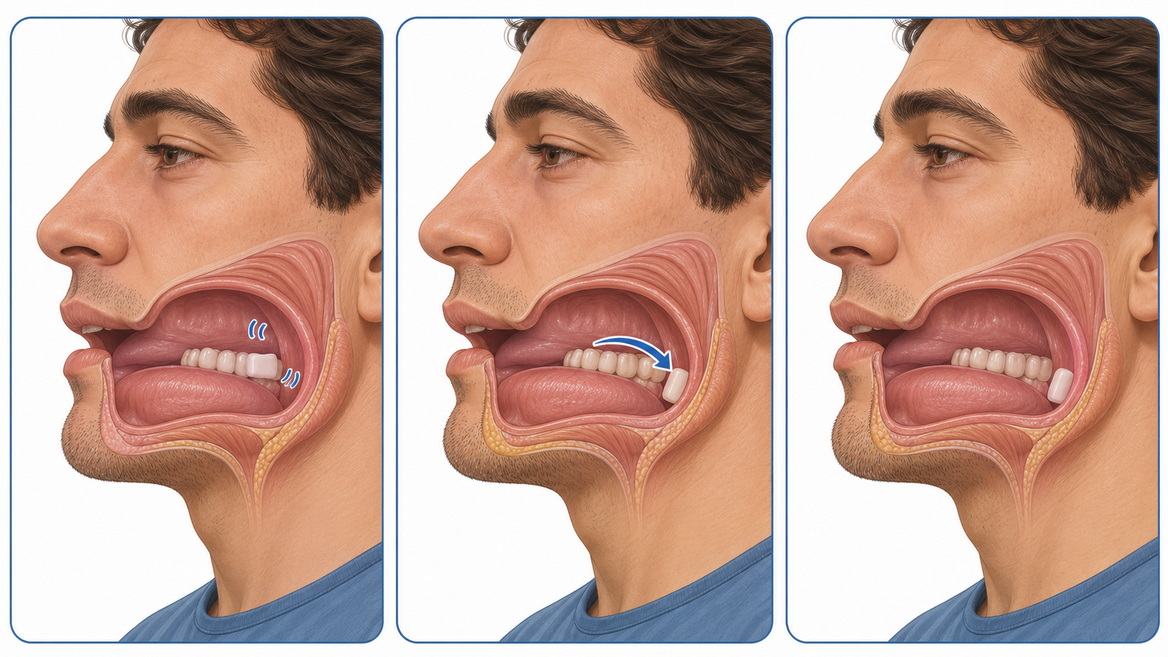
Ordinary gum is designed for repeated chewing. Medicinal nicotine gum uses a chew-and-park technique.
You chew slowly until a tingling sensation develops, then rest the gum between your cheek and gums. Nicotine is absorbed mainly through the lining of the mouth.
Chewing continuously can contribute to mouth or jaw soreness. It can also increase unwanted effects such as hiccups, stomach discomfort, excessive saliva, or nausea.
A fruit flavour changes the taste experience. It does not change the basic technique.
Jaw fatigue after repeated chewing deserves attention, but it does not establish a diagnosis. Existing jaw-joint problems, dental issues, and other causes may affect which nicotine replacement product is suitable.
Do not assume that changing flavours or switching nicotine formats will resolve persistent pain.
Professional assessment becomes particularly important when discomfort interferes with eating, continues despite technique changes, or occurs alongside other dental symptoms.
The first question should be: "What is causing the discomfort?" rather than "Which nicotine product should replace this one?"
Approved nicotine gum can help adults manage withdrawal symptoms and cravings while stopping smoking. Its established therapeutic role is an important advantage over products marketed primarily as nicotine alternatives.
Fruit flavours may offer a more acceptable taste for someone who dislikes mint or the taste of their current gum. However, flavour preference should not be confused with stronger craving relief or better jaw comfort.
Useful characteristics include:
- An established smoking-cessation purpose.
- Labelled strengths and product-specific instructions.
- Intermittent use within a structured treatment plan.
- The possibility of combining gum with a nicotine patch when appropriate.
For a former smoker, treatment success means maintaining smoking abstinence with manageable side effects—not simply finding a more enjoyable nicotine flavour.
Nicotine gum may be inconvenient for people who struggle to stop chewing automatically. It can also stick to dentures, dental caps, or partial bridges.
Someone with an existing jaw-joint disorder should discuss suitability with a healthcare professional before using it.
Fruit nicotine gum is therefore not automatically the best option for someone with a strong continuous-chewing habit. The relevant question is whether they can use it comfortably and correctly.
Importantly, "nicotine gum" on a package does not prove that a product is an approved medicine.
Nicotine pouches do not require chewing, so they avoid the repetitive movement involved in gum use. That is a mechanical difference, not evidence that they treat jaw fatigue or temporomandibular joint problems.
They also introduce a different exposure pattern: prolonged contact between the pouch and oral tissues.
Potential concerns include mouth irritation, nausea, oral lesions, and nicotine dependence. Product strength and labelling may also be unreliable in unregulated markets.
"Tobacco-free" does not mean nicotine-free or risk-free.
A product can deliver nicotine without having established evidence as a smoking-cessation treatment.
Nicotine pouches have not been approved by the FDA as a quit-smoking aid. Their long-term health effects remain uncertain, and evidence supporting sustained smoking cessation is limited.
This matters because an immediate sensation of craving relief is different from maintaining smoking abstinence over time.
For someone already smoke-free, replacing gum with a pouch may also continue nicotine dependence without addressing the original problem: uncomfortable chewing or an unsuitable treatment plan.
Before abandoning an otherwise suitable medicinal gum, review the instructions with a pharmacist.
Confirm that it is an approved nicotine replacement medicine. Check the strength, expiry date, warnings, and maximum daily use stated on its own label.
Do not apply instructions from another brand or country automatically.
Bite down slowly until tingling develops. Then park the gum between the inside of your cheek and your gums.
The parking stage is part of treatment, not a break from treatment.
When the sensation fades, repeat the slow chew-and-park process according to the product instructions.
General guidance commonly describes a session lasting around 30 minutes. That does not mean 30 minutes of uninterrupted chewing.
Avoid eating or drinking for 15 minutes before use and while using the gum, unless your product instructions specify otherwise.
Acidic drinks, including coffee and soft drinks, can interfere with nicotine absorption.
Do not increase chewing intensity to chase a stronger sensation. If correct use remains uncomfortable, ask about another approved treatment rather than pushing through pain.
The most useful comparison separates issues that often get bundled together.
Cravings may suggest that the treatment strength, timing, or overall plan needs review.
A pharmacist can assess whether your current approach provides appropriate withdrawal support. Do not assume that stronger sensations mean better treatment.
Some former smokers miss the repeated hand-to-mouth or oral routine associated with smoking.
Nicotine delivery and behavioural habits are related, but they are not identical. Repeatedly adding nicotine is not necessarily the right response to every habitual urge.
Behavioural support can help identify triggers and develop responses that do not depend entirely on a nicotine product.
Pain requires its own assessment. Switching to a stationary product may remove chewing while leaving another problem unresolved.
Separating these three issues makes the conversation with a pharmacist or dentist more productive—and helps avoid unnecessary product switching.
A short record can help explain what is happening without guessing at the cause.
For several days, note:
- The exact product and nicotine strength.
- When and how often you use it.
- Whether you chew continuously or park it.
- When discomfort starts and how long it lasts.
- Any nausea, hiccups, mouth irritation, or dental difficulties.
- Other nicotine products used during the same period.
This is an observation tool, not a diagnostic test. Do not delay assessment for significant or worsening symptoms simply to complete the record.
Bring the packaging to your appointment. Clear product information is more useful than describing a gum or pouch only by flavour.
A nicotine patch delivers nicotine through the skin and requires no chewing or placement against oral tissues.
For someone whose main difficulty is repeated jaw movement, it is a relevant option to discuss. Suitability depends on their nicotine dependence, health history, and treatment goals.
Lozenges are another approved nicotine replacement format. They dissolve in the mouth rather than requiring repeated chewing.
They still need correct use and can cause side effects, so they are not automatically suitable for everyone.
A patch plus a short-acting nicotine replacement product can improve smoking-cessation outcomes compared with a single form for some people.
A pharmacist can advise whether a patch-and-lozenge approach would reduce reliance on gum while maintaining craving support.
Do not independently stack multiple nicotine products. A structured treatment plan is different from adding products whenever discomfort or cravings appear.

For Australian readers, availability is not simply a matter of choosing between two online listings.
From 24 July 2026, there is no longer a lawful consumer pathway to buy or import nicotine pouches in Australia. Retailers, including online sellers, cannot lawfully sell them to Australian consumers. A prescription does not restore the former personal-import pathway.
Approved nicotine replacement therapies remain available.
A separate safety warning issued on 30 October 2026 also highlighted unapproved nicotine gum products being unlawfully supplied in Australia. These had not been assessed for quality, safety, or efficacy.
The practical lesson is to verify medicinal approval, not just product category. Neither attractive packaging nor a familiar flavour establishes that a nicotine product meets Australian requirements.
For this comparison, the most defensible conclusion is not "pouches win because they require no chewing."
It is:
1. Review whether nicotine gum is being used correctly.
2. Confirm that the product is an approved medicine.
3. Have persistent jaw or mouth symptoms assessed.
4. Discuss a lower-chewing approved treatment if necessary.
5. Keep the plan focused on staying smoke-free and managing dependence.
As a retailer-published educational resource, this article should support informed decisions rather than present a commercial nicotine product as a treatment for pain.
Before changing products, take your current packaging and symptom notes to a pharmacist. Australian readers can also call Quitline on 13 7848 for smoking-cessation support.
There is no basis here to claim that fruit flavour reduces jaw workload. Chewing technique, frequency of use, and existing jaw problems are more relevant than flavour alone.
No. They do not require chewing, but that does not establish them as a treatment for jaw fatigue. They can also cause oral irritation and maintain nicotine dependence.
Follow the medicinal instructions rather than treating flavour as a dosing guide. Nicotine gum generally requires intermittent chewing and parking, not continuous chewing until it becomes tasteless.
No. The labelled nicotine amount does not establish identical absorption or effects across formats. Do not substitute products milligram for milligram without professional advice.
Ask a pharmacist about approved options such as patches or lozenges. Persistent pain also needs assessment rather than repeated product experimentation.
No. From 24 July 2026, the previous personal-import pathway is no longer available, including with a prescription. Approved cessation treatments remain available through lawful channels.
The sources below support the treatment instructions, safety comparisons, and regulatory statements. The decision framework and symptom record are editorial tools, not validated clinical protocols.
1. Centers for Disease Control and Prevention. "How to Use Nicotine Gum." Instructions, side effects, dental considerations, and precautions. [beta.cdc]
2. Centers for Disease Control and Prevention. "Nicotine Pouches." Product characteristics, dependence risks, evidence limitations, and cessation status. Published January 31, 2025. [cdc]
3. Centers for Disease Control and Prevention. "Coverage for Tobacco Use Cessation Treatments." Evidence supporting counselling, medicines, and combination nicotine replacement therapy. [archive.cdc]
4. Therapeutic Goods Administration. "Nicotine Pouches." Published July 17, 2026. Australian consumer-access restrictions effective July 24, 2026, and available cessation support. [tga.gov]
5. Therapeutic Goods Administration. "TGA Warning About Unapproved Nicotine Gum Products." Published October 30, 2026. Product-quality concerns and approved medicinal gum. [tga.gov]
6. Therapeutic Goods Administration. "New Regulations Strengthen Controls on Nicotine Pouches." Published July 17, 2026. Regulatory changes and approved treatment alternatives. [tga.gov]
This website contains products intended for adults only.
Are you 18 years of age or older?
WARNING: This product contains nicotine. Nicotine is an addictive chemical.


