
Language
Views: 229 Author: 7DaysVape Publish Time: 2026-11-16 Origin: Site


Content Menu
● Refillable vs Disposable Vapes: What Is the Difference?
● What Does "Hits Like a Disposable" Actually Mean?
>> Sensation Is Not a Nicotine Measurement
>> Similar Descriptions Do Not Establish Equivalence
● Why Advertised Puff Counts Need Context
>> Ask What Was Actually Measured
>> Do Not Treat Puff Counts as Cigarette Equivalents
● Reading Specifications Without Overinterpreting Them
>> Battery Capacity Is Not Guaranteed Runtime
>> Liquid Capacity Is Not a Safety Measure
>> Compatibility Must Be Product-Specific
● What E-Cigarette Aerosol Contains—and Why It Matters
>> Nicotine-Free Does Not Mean Risk-Free
>> Risk Comparisons Need a Clear Reference Point
● A Practical Framework for Evaluating Product Claims
>> Step 1: Identify the Exact Claim
>> Step 2: Match the Evidence to the Question
>> Step 3: Record What Remains Unknown
● How to Read User Reviews Responsibly
● Australian Vaping Rules: Why Local Context Matters
>> Access Depends on More Than Age
● Battery Safety, Liquid Exposure, and Disposal
>> Keep Products Away From Children and Pets
>> Do Not Confuse Reuse With Harmlessness
● Before Making a Health Decision
>> Is a refillable vape safer than a disposable vape?
>> Does a rechargeable disposable become a refillable device?
>> Can puff counts show how much nicotine someone absorbs?
>> Are nicotine-free electronic cigarettes harmless?
>> Can ordinary vape shops legally sell vapes in Australia?
>> Can customer reviews prove that a product is safe?
>> What should someone do if vaping causes health concerns?
A refillable vape and a disposable vape may look different, but both are electronic cigarettes that heat liquid to create an inhaled aerosol. Understanding their differences requires more than comparing flavours, battery sizes, or advertised puff counts. Product design, maintenance, nicotine exposure, legal requirements, and disposal all matter.
For adults reviewing information about electronic cigarettes, the most useful question is not which device "hits harder" or recreates another product's sensation. It is whether the available information is accurate, relevant, and supported by evidence.
This guide explains how to interpret common claims, distinguish specifications from personal impressions, and recognise important safety limitations. It does not recommend particular products or provide instructions for increasing nicotine delivery.
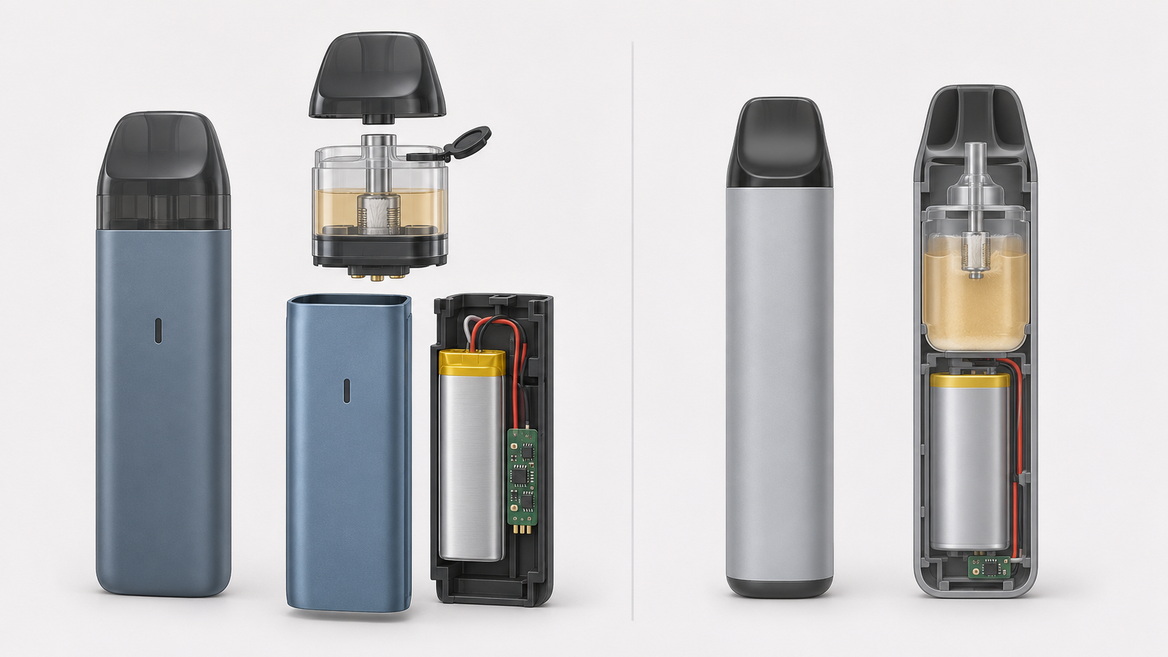
The main distinction concerns which components are intended to be reused.
A refillable device generally retains its battery and allows the liquid reservoir to be replenished. Depending on the design, other components may require replacement.
A disposable device is intended to be discarded when its usable liquid or component life is exhausted. Some disposable devices have rechargeable batteries. Consequently, "rechargeable" does not necessarily mean "refillable."
Pod-based devices introduce another distinction: a reusable battery can accept either refillable or prefilled replacement pods.
| Product description | What it generally means | What it does not establish |
|---|---|---|
| Refillable | The intended reservoir can be replenished | Universal liquid compatibility |
| Rechargeable | The battery can be charged again | Refillable construction or indefinite service life |
| Prefilled pod | A replaceable pod arrives containing liquid | Permission to open or refill it |
| Disposable | The complete product has a limited intended service life | Battery-free construction or safe household disposal |
These descriptions concern construction, not health outcomes. A reusable format does not automatically make inhaling its aerosol safe.
The phrase combines several subjective impressions rather than describing a recognised measurement.
One person may mean a particular throat sensation. Another may be describing airflow resistance, flavour intensity, or how quickly a device responds. A third may associate the phrase with nicotine effects.
Those experiences are not interchangeable.
A smooth inhalation does not prove that nicotine exposure is low. Likewise, a strong throat sensation does not provide a reliable measurement of the amount absorbed.
Nicotine formulation and product design can affect how an aerosol feels. Some nicotine salt formulations allow high nicotine concentrations without the same perceived harshness associated with other formulations.
The practical lesson is simple: sensory impressions cannot replace verified labelling, product documentation, or clinical advice.
Two products described as "smooth" may differ in composition, emissions, and nicotine delivery.
A meaningful equivalence claim would need a clearly defined outcome and an appropriate comparison method. Without those details, "feels the same" remains an individual report—not proof of comparable performance or risk.
A large puff number appears precise, but precision in presentation is not the same as certainty in practice.
The number cannot be interpreted properly without knowing how it was generated.
Before treating a puff claim as evidence, look for:
- The duration and volume of each test puff.
- The interval between puffs.
- The operating conditions.
- The definition of the test endpoint.
- The number of samples tested.
- Whether results were independently verified.
If those details are unavailable, the claim has limited value for predicting an individual's experience.
A laboratory sequence is also not automatically equivalent to a person's daily behaviour. Turning an advertised puff count into a guaranteed number of days adds another unsupported assumption.
A puff is not a standard unit of nicotine exposure across products.
Claims that a device equals a specific number of cigarettes require a defined basis. Liquid volume, nicotine content, aerosol output, and nicotine absorbed by the body describe different things.
An unexplained conversion can create a misleading impression of certainty. It should not guide decisions about nicotine dependence or health.
Product specifications can answer narrow technical questions. Problems arise when a narrow measurement becomes a broad promise.
Battery capacity describes an electrical characteristic. It does not independently establish how many hours or days a device will operate.
A runtime comparison should disclose operating conditions and explain whether both products were assessed consistently.
Statements such as "lasts all week" are incomplete without that context.
Reservoir capacity describes volume. It does not prove manufacturing quality, ingredient accuracy, lower emissions, or reduced health risk.
A larger reservoir should therefore not be presented as evidence of a safer product.
"Works with any e-liquid" is too broad to accept without documentation.
Compatibility should be checked against the manufacturer's instructions for the exact device and component. A reviewer's preference is not a substitute for those instructions.
This guide does not provide liquid-mixing, device-modification, or nicotine-adjustment instructions.
The visible cloud from an electronic cigarette is an aerosol, not harmless water vapour.
Depending on the product and conditions, it can contain nicotine, tiny particles, volatile organic compounds, heavy metals, and other harmful or potentially harmful substances.
An ingredient being suitable for food does not establish that it is safe to inhale. The digestive system and lungs encounter and process substances differently.
Removing nicotine does not eliminate every potential hazard associated with an inhaled aerosol.
Label accuracy is another concern. Public health agencies have reported finding nicotine in some products marketed as nicotine-free.
This does not establish that every label is inaccurate. It does mean that a label claim alone is not equivalent to independent verification.
Comparing vaping with smoking is different from comparing vaping with using neither product.
Public health guidance recognises that completely replacing smoked tobacco with e-cigarettes may offer potential benefits for some nonpregnant adults who smoke. That does not make vaping harmless or justify encouraging people who do not smoke to start.
Using both cigarettes and e-cigarettes is also not a reliable way to protect health. Smoking even a small number of cigarettes remains dangerous.
A useful review should separate four evidence categories.
| Evidence category | What it can contribute | Important limitation |
|---|---|---|
| Manufacturer documentation | Intended use, specifications, warnings | Commercial claims may need independent verification |
| Independent testing | Results under defined conditions | Findings may not apply to every batch or setting |
| User feedback | Reports of usability or recurring problems | Cannot establish safety or typical outcomes |
| Public health guidance | Health context and population-level advice | Usually does not validate a particular device |
"High quality" is vague. "The manufacturer lists a particular battery capacity" is specific.
The clearer the claim, the easier it is to determine what evidence would support it.
A photograph may document a visible defect. It cannot establish aerosol chemistry.
A satisfaction survey may describe preferences. It cannot demonstrate that a product is safe.
Transparent uncertainty improves an article.
Where testing conditions, ingredient verification, or long-term evidence are missing, say so. Avoid filling gaps with confident language.
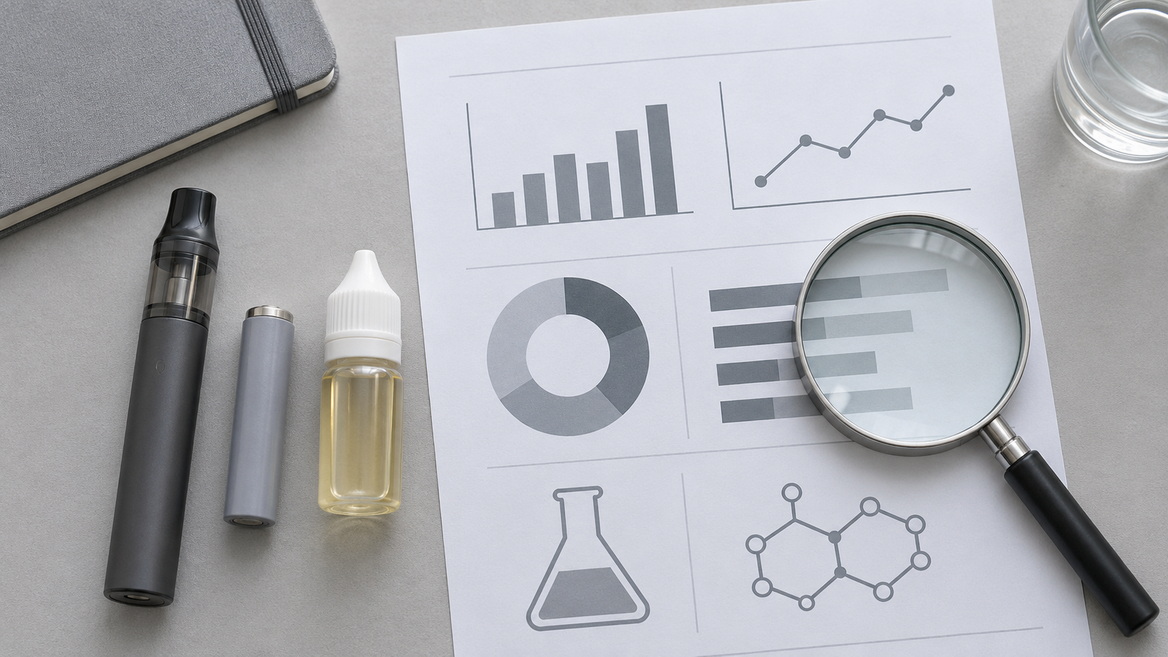
Reviews can highlight issues worth investigating, including confusing instructions, damaged packaging, or inconsistent experiences.
However, a review does not become representative simply because it is detailed or enthusiastic.
Look for:
1. Identification of the exact product and version.
2. A clear description of what happened.
3. Disclosure of free samples or incentives.
4. Separation of observation from speculation.
5. Similar reports from genuinely independent contributors.
No verified customer-review dataset was supplied for this article. Accordingly, it includes no invented testimonials, customer quotations, satisfaction percentages, or claims of first-hand product testing.
That distinction matters: editorial interpretation should never be disguised as personal experience.
For Australian readers, product comparisons must be understood within the therapeutic supply framework.
Under the national rules introduced in 2024, vapes and vaping products can only be sold through pharmacies for smoking cessation or nicotine-dependence management, subject to applicable requirements. This framework applies regardless of whether products contain nicotine.
Other retailers cannot legally sell them merely because they describe the products as nicotine-free.
Since 1 October 2024, adults aged 18 and over may obtain certain therapeutic vapes containing no more than 20 mg/mL nicotine from participating pharmacies without a prescription, where state and territory laws allow and required conditions are met.
A pharmacist consultation is required. Higher nicotine concentrations require a prescription, and additional restrictions apply.
Single-use disposable vapes cannot be purchased through pharmacies. Therapeutic vape flavours are restricted to mint, menthol, and tobacco.
These rules should not be interpreted as permission for unrestricted online retail supply. Check current national and local requirements rather than relying on a product page or international shipping statement.
Electronic cigarettes combine electrical components with liquids that may contain toxic nicotine.
Defective batteries have caused fires and explosions. Nicotine exposure through swallowing or contact with skin or eyes can also cause poisoning.
Store devices and liquids securely, including products awaiting disposal. A used container should not be assumed to be harmless.
If nicotine poisoning is suspected, seek medical help immediately. Do not wait for an online discussion or product review to establish the cause.
Refillable construction does not eliminate battery hazards or liquid-related risks.
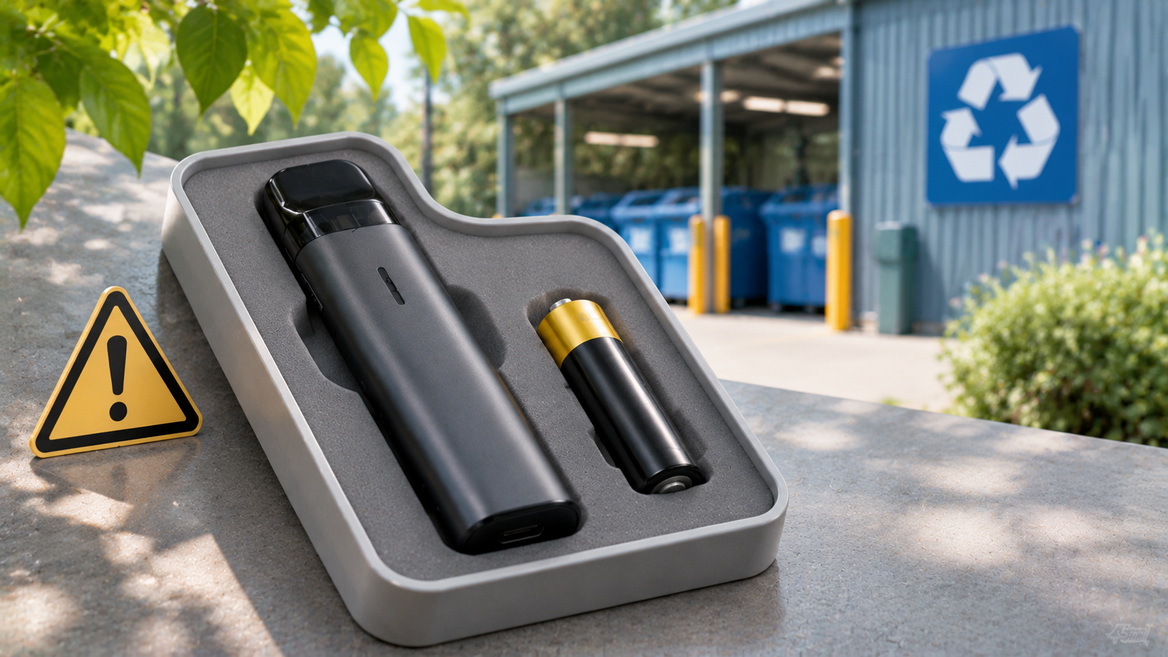
Similarly, a small disposable device still contains materials requiring appropriate handling. Consult local council or waste-service guidance for the complete device, battery, and residual liquid.
Do not dismantle a sealed product simply to make it fit a disposal category.
If you do not smoke or use nicotine, do not start vaping.
If you smoke, speak with a qualified healthcare professional about cessation treatments and support suited to your circumstances. If you already vape, discuss nicotine dependence and a plan for stopping.
Bring your questions and any available product documentation to the consultation. A review article can help organise those questions; it cannot diagnose symptoms or replace individual medical advice.
The refillable or disposable label alone cannot establish safety. Composition, emissions, manufacturing quality, and patterns of exposure matter. Neither category should be described as harmless.
No. Rechargeability concerns the battery. Refillability concerns the intended liquid reservoir. One feature does not establish the other, and sealed devices should not be modified.
Not by themselves. Puff numbers do not provide a standard measure of nicotine absorption across products. Any exposure comparison needs a defined method and supporting evidence.
No. Aerosol may contain harmful substances even without nicotine. Some products labelled nicotine-free have also been found to contain nicotine, so label accuracy matters.
Under Australia's therapeutic supply framework, vape sales are restricted to pharmacies and applicable conditions. Non-pharmacy retailers cannot legally sell vapes simply by labelling them nicotine-free.
No. Reviews can describe individual experiences or flag possible problems. They cannot establish chemical safety, long-term health effects, or compliance with regulatory requirements.
Seek advice from a healthcare professional. Suspected nicotine poisoning requires immediate medical help. Do not rely on changing devices or following anonymous online troubleshooting advice.
- Centers for Disease Control and Prevention. "About E-Cigarettes (Vapes)." Source for device definitions, aerosol composition, nicotine labelling limitations, and nicotine salt context. [cdc]
- Centers for Disease Control and Prevention. "Health Effects of Vaping." Source for health risks, nicotine exposure, battery injuries, and the distinction between complete substitution and dual use. [cdc]
- Australian Government Department of Health, Disability and Ageing. "About Vaping and E-Cigarettes." Source for Australian supply restrictions, therapeutic access conditions, flavour restrictions, and disposable-device restrictions. [health.gov]
- Australian Government Department of Health, Disability and Ageing. "Vaping Laws." Source for the pharmacy-only framework and age, prescription, and consultation requirements. [health.gov]
- Australian Government Department of Health, Disability and Ageing. "Facts About Vaping and How to Quit." Source for cessation support and the importance of clinical guidance. [health.gov]
This website contains products intended for adults only.
Are you 18 years of age or older?
WARNING: This product contains nicotine. Nicotine is an addictive chemical.


