
Language
Views: 246 Author: 7DaysVape Publish Time: 2026-11-20 Origin: Site


Content Menu
>> Does "Tobacco-Free" Mean Nicotine-Free?
● Why "Top 10 Nicotine Pouches" Rankings Need Context
>> Popularity Is Not a Clinical Finding
>> What a Credible Comparison Should Disclose
● Are Nicotine Pouches Legal in Australia?
>> Why Older Prescription Advice Is Outdated
>> Does an Overseas Listing Prove Australian Availability?
● Nicotine Pouch Health Risks: What Is Established?
>> Smoke-Free Does Not Mean Risk-Free
● How to Read Nicotine Pouch Labels Without Misinterpreting Them
>> Milligrams per Pouch Versus Milligrams per Gram
>> Why "Strong" and "Smooth" Are Poor Measurements
● Nicotine Pouches, Vapes, and Nicotine Replacement Therapy
>> Can Nicotine Pouches Help Someone Quit Smoking?
● How to Interpret User Reviews Responsibly
>> What Useful Review Evidence Looks Like
● A Practical Checklist for Assessing Online Claims
>> 1. Check the Publication and Update Dates
>> 2. Identify the Type of Evidence
>> 3. Look for Missing Qualifications
>> 4. Separate Information From Purchasing Pressure
● Frequently Asked Questions About Nicotine Pouches
>> Are nicotine pouches the same as snus?
>> Are nicotine pouches safe because they do not produce smoke?
>> Can Australians import nicotine pouches with a prescription?
>> Does tobacco-free nicotine always mean synthetic nicotine?
>> Can nicotine strength be compared directly with cigarettes?
>> Are customer reviews enough to judge safety?
>> What should someone do if they want help stopping nicotine use?
● Make Health and Legal Information the Starting Point
Nicotine pouches appear frequently in searches for smoke-free nicotine products, often alongside electronic cigarettes, disposable vape devices, and e-liquid. Yet these categories differ in how they deliver nicotine, how authorities regulate them, and what researchers know about their health effects. Understanding those differences matters more than finding a product at the top of a ranking.
This guide examines nicotine pouches without treating popularity, flavour variety, or discreet packaging as proof of quality. It explains the limitations of product comparisons, the meaning of common label claims, and the regulatory changes Australian readers need to understand.
This is general educational information, not medical advice, a product endorsement, or an invitation to purchase nicotine products.
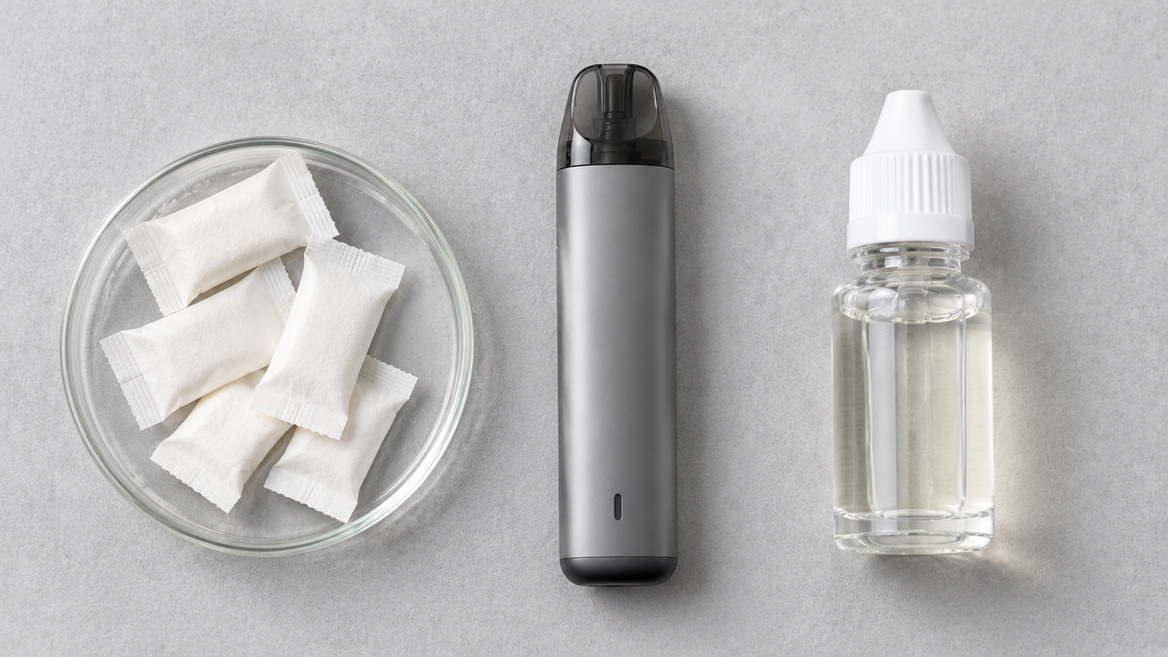
Nicotine pouches are small oral products containing nicotine, flavourings, and other ingredients inside a permeable pouch. Nicotine is absorbed through the gums and lining of the mouth.
Unlike cigarettes, these products do not burn tobacco. Unlike a vape, they do not heat e-liquid to create an inhaled aerosol. Their nicotine can come from tobacco plants or be produced synthetically.
Those distinctions describe the product format. They do not establish that the product is harmless.
No. A product can contain no tobacco leaf while still delivering nicotine.
"Tobacco-free" can also be ambiguous when readers assume it describes the origin of every ingredient. Some products use tobacco-derived nicotine; others use synthetic nicotine. Neither description removes nicotine's addictive properties.
A useful reading habit is to separate three questions:
- Does the product contain tobacco leaf?
- Does it contain nicotine?
- What evidence supports its health claims?
A reassuring answer to the first question does not answer the other two.
The original 2025 article compared ZYN, ROGUE, Juice Head, on!, VELO, OEO, ZIMO, Lucy, Pillowz, and BSX.
Its descriptions focused largely on flavour, pouch counts, format, and claimed duration. These details may describe a retail range, but they cannot independently establish safety, manufacturing consistency, or suitability for an individual.
A bestseller label measures commercial performance only when the underlying sales data are available and clearly defined.
It does not demonstrate:
- Lower dependence potential.
- Reliable nicotine delivery.
- Better long-term oral health.
- Effectiveness for stopping smoking.
- Legal availability in another country.
Similarly, an attractive flavour description is a subjective marketing statement, not evidence of a health benefit.
A transparent comparison should explain its evidence before presenting conclusions.
| Comparison area | Information needed | What it cannot establish alone |
|---|---|---|
| Nicotine content | Exact unit and product version | Nicotine absorbed by each person |
| Ingredients | Current label and formulation details | Long-term safety |
| Pouch count | Number in the specific pack | Overall product quality |
| Consumer feedback | Sample size, dates, and collection method | Medical effectiveness |
| Regulatory status | Country and relevant date | Worldwide permission to sell |
| Product testing | Laboratory methods and tested batches | Consistency across every batch |
Without these details, a numbered list is better understood as an editorial selection than a reproducible assessment.
For Australian readers, this is the first practical question—not an issue to leave until after a brand comparison.
The Therapeutic Goods Administration states that, from 24 July 2026, consumers no longer have a lawful pathway to buy or import nicotine pouches in Australia through the previously available consumer access arrangements.
Retailers, including online sellers, cannot lawfully sell nicotine pouches in Australia. Medical practitioners cannot prescribe them to patients, and pharmacies cannot compound or supply them through the former pathways.
The TGA also states that no nicotine pouch product is included on the Australian Register of Therapeutic Goods.
Earlier information may describe personal importation with a prescription. That advice does not reflect the July 2026 changes.
The changes removed access through the Personal Importation Scheme, Special Access Scheme, and Authorised Prescriber Scheme, as well as pharmacist compounding.
The TGA identifies narrow statutory circumstances, such as qualifying clinical research, separately. These are not ordinary consumer shopping routes.
No. A product page, international delivery option, or overseas regulatory classification does not establish permission to import a product into Australia.
The TGA states that nicotine pouches imported into Australia can be seized at the border and destroyed.
For that reason, international product descriptions should never be presented as Australian purchasing guidance.
Nicotine is highly addictive. Changing the delivery format does not remove that risk.
Public health authorities advise that young people, young adults, and pregnant women should not use nicotine pouches. People who do not currently use tobacco or nicotine products should not start.
Nicotine can harm adolescent brain development, which continues into the mid-twenties. It also presents risks during pregnancy.
Not burning tobacco changes the exposure profile, but "smoke-free" is not a complete safety assessment.
The absence of smoke cannot establish that a product is safe for the mouth, cardiovascular system, pregnancy, or long-term use.
It is also important not to transfer findings automatically between categories. Research on cigarettes, traditional smokeless tobacco, vaping products, and nicotine pouches addresses different exposures.
A precise explanation acknowledges both differences and uncertainty.
Researchers are still investigating the short- and long-term effects of nicotine pouches.
The TGA highlights concerns about high or inconsistent nicotine content, inaccurate labels, potential contaminants, and products made in unregulated facilities.
These concerns do not prove that every pouch contains an undisclosed contaminant. They explain why packaging and retail claims cannot substitute for independent evaluation.
Likewise, limited long-term evidence is not evidence that long-term harm is absent.
Labels can create a sense of precision while leaving important questions unanswered.
The first issue is the unit attached to the nicotine figure. A value expressed per pouch is different from a concentration expressed per gram.
"Milligrams per pouch" describes the stated nicotine content of one pouch.
"Milligrams per gram" describes nicotine concentration by product weight. Without the pouch weight, the two figures cannot be compared directly.
Neither figure, on its own, tells a reader exactly how much nicotine a particular person will absorb.
Avoid converting these numbers into claims such as "equivalent to one cigarette" unless robust evidence supports that specific comparison.
Words such as "strong," "smooth," and "intense" do not provide a standardised clinical measurement.
A flavour sensation cannot verify nicotine content. A mild sensation cannot establish low exposure. A cooling description cannot establish product safety.
Similarly, "up to one hour" is a product-duration claim, not proof of a predictable nicotine dose or a recommended exposure period.
Treat sensory language as description, not measurement.

These categories are sometimes grouped together because they can contain nicotine. Their delivery systems, evidence bases, and regulatory treatment are not interchangeable.
| Category | Basic delivery format | Important distinction |
|---|---|---|
| Nicotine pouches | Nicotine absorbed through the mouth | Not equivalent to an approved cessation medicine |
| Electronic cigarettes | Inhaled aerosol from heated liquid | Aerosol can contain harmful substances |
| Disposable vape devices | An electronic-cigarette format | Disposable design does not establish safety |
| E-liquid | Liquid intended for compatible vaping devices | Ingredients and nicotine content vary |
| Approved nicotine replacement therapy | Regulated medicinal formats | Used according to approved directions and clinical guidance |
The phrase "e vape" is another search term associated with electronic cigarettes, not a separate medical classification.
The CDC states that nicotine pouches are not approved by the United States Food and Drug Administration as a smoking cessation aid.
The TGA also describes evidence supporting their use for smoking cessation as limited.
Moving from smoking to another nicotine product should not automatically be described as successful treatment of nicotine dependence. Continued dependence and continued smoking are separate outcomes that need assessment.
A healthcare professional can discuss approved treatments and behavioural support without relying on retail rankings.
Reviews can describe individual experiences, but they have clear limits.
A person's report about flavour, packaging, or mouthfeel does not establish product composition, nicotine absorption, or long-term safety.
For this article, no verified customer-review dataset was supplied. The original page displayed no published comments when reviewed. Therefore, there is no defensible basis for claims such as "most customers prefer" or "users consistently report."
When evaluating published feedback, look for:
1. The exact product version and market.
2. The review date.
3. Whether the purchase was verified.
4. Whether incentives or free products were involved.
5. Whether negative feedback appears alongside positive feedback.
6. Whether the conclusion matches the size of the sample.
A handful of favourable comments should not become a claim about all consumers.
Reported health symptoms also require appropriate medical assessment, not reassurance from other reviewers.
Before accepting information about nicotine pouches, work through the following checks.
A 2025 article may still describe a brand's historical range, but its legal guidance may be obsolete.
For Australian content, the July 2026 regulatory changes are a clear example of why dates matter.
Ask whether the statement comes from a regulator, a research study, a manufacturer, a retailer, or an individual reviewer.
These sources answer different questions. A retailer can describe its listings; that does not make it an independent authority on health outcomes.
Be cautious when "tobacco-free" becomes "safe," "popular" becomes "proven," or "smoke-free" becomes "healthy."
Each change introduces a conclusion that needs separate evidence.
Countdown offers, flavour-led rankings, and urgency-based messages do not resolve questions about health or legality.
An informative article should help readers recognise uncertainty rather than hurry them past it.
No. Nicotine pouches generally contain nicotine without tobacco leaf. Snus contains tobacco. However, the absence of tobacco leaf does not make nicotine pouches nicotine-free or harmless.
No. They avoid combustion, but nicotine remains addictive, and important questions about long-term health effects remain unresolved. "Smoke-free" describes one characteristic, not an overall safety conclusion.
Not through the former consumer pathways. From 24 July 2026, the TGA removed personal importation and other previously available access arrangements. An overseas seller accepting an order does not establish that importation is lawful.
No. Tobacco-free wording can refer to the absence of tobacco leaf in the finished product. Nicotine may still originate from tobacco plants. Check the precise claim rather than assuming what it means.
A pouch's labelled nicotine content does not establish a reliable cigarette equivalent. Product content and the amount absorbed are different measurements, so simple equivalence claims can mislead.
No. Reviews can provide subjective descriptions, but they cannot verify laboratory composition or establish long-term health outcomes. They should not replace regulatory information or qualified healthcare advice.
Speak with a doctor or pharmacist about evidence-based support and approved treatment options. Explain all current nicotine use so the discussion addresses dependence rather than just replacing one product with another.
The most useful nicotine pouch guide is not necessarily the one with the longest flavour list. It is the one that distinguishes established evidence from sales language, explains uncertainty, and reflects current local rules.
If you currently use nicotine and want to stop, speak with a qualified healthcare professional about a cessation plan. If you do not use nicotine, do not start.
1. [Element Vape — "Top 10 Nicotine Pouches For 2025," published January 14, 2025]. Original article reviewed for its brand coverage, comparison structure, product claims, and absence of published comments. Not treated as independent health evidence. [elementvape]
2. [Therapeutic Goods Administration — "Nicotine pouches"]. Australian consumer access, importation and retail restrictions, product evaluation status, and health uncertainties. [tga.gov]
3. [Therapeutic Goods Administration — "New regulations strengthen controls on nicotine pouches," July 17, 2026]. Changes taking effect on July 24, 2026, including the removal of former access pathways. [tga.gov]
4. [Centers for Disease Control and Prevention — "Nicotine Pouches," January 31, 2025]. Product definition, nicotine absorption, addiction, vulnerable populations, research limitations, and smoking-cessation approval status. [cdc]
5. [Centers for Disease Control and Prevention — "Health Effects of Vaping," January 31, 2025]. Electronic-cigarette aerosol, nicotine risks, and the distinction between reduced exposure and safety. [cdc]
6. ["Nicotine Pouches: A Summary of Regulatory Approaches Across 67 Countries," available through CDC Stacks]. Background on nicotine sources, product definitions, and differences between national regulatory approaches. Historical regulatory findings are not used as current Australian guidance. [stacks.cdc]
7. [Therapeutic Goods Administration — "Guidance on the use of vapes for smoking cessation or the management of nicotine dependence"]. Clinical context for registered treatments, behavioural support, and the distinction between therapeutic decisions and retail product comparisons. [tga.gov]
This website contains products intended for adults only.
Are you 18 years of age or older?
WARNING: This product contains nicotine. Nicotine is an addictive chemical.


