
Language
Views: 223 Author: 7DaysVape Publish Time: 2026-10-17 Origin: Site


Content Menu
● What Are Fruit Nicotine Pouches and Hookah Products?
>> Fruit nicotine pouches: oral nicotine without tobacco leaf
>> Hookah products: preparations heated for inhalation
>> Why "hookah juice" needs clarification
● Fruit Nicotine Pouches vs Hookah: An At-a-Glance Comparison
● Can Fruit Nicotine Pouches Replicate Shisha Flavors?
>> A shared flavor label is not an equivalence test
>> Delivery route changes the comparison
● Nicotine Exposure: Why Product Strength Is Not the Whole Story
>> Nicotine content and absorbed dose are different questions
>> Hookah exposure depends on the session
● Health Considerations: Different Routes, Different Concerns
>> Hookah smoke introduces combustion-related hazards
>> Nicotine pouches avoid smoke but retain nicotine risks
>> Who should not interpret this comparison as an invitation?
● Three Common Comparison Errors—and How to Correct Them
>> Error 1: Treating "smoke-free" as "risk-free"
>> Error 2: Treating a product category as a uniform formula
>> Error 3: Confusing substitution with cessation
● Australia: What Readers Need to Know
● A Practical Checklist for Evaluating Health Claims
>> Are fruit nicotine pouches the same as shisha?
>> Does hookah water remove harmful chemicals?
>> Are tobacco-free nicotine pouches nicotine-free?
>> Can nicotine pouches be called a proven quitting aid?
>> Can Australians import nicotine pouches with a prescription?
>> Can one pouch be converted into a number of hookah sessions?
Fruit nicotine pouches and hookah products can feature similar flavor descriptions, but they are fundamentally different nicotine-delivery systems. Pouches expose the mouth to a nicotine-containing mixture without burning it. Traditional hookah use involves inhaling smoke generated by heating a preparation, often with charcoal. Understanding that distinction matters more than matching labels such as apple, grape, or watermelon. [cdc]
The central point is exposure: a familiar fruit flavor does not establish equivalent ingredients, nicotine absorption, health effects, or suitability as a substitute. Neither category should be described as harmless, and the long-term effects of nicotine pouches remain incompletely understood. [cdc]
This comparison examines the terminology, practical differences, evidence limitations, and Australian regulatory context. It does not recommend starting either product.
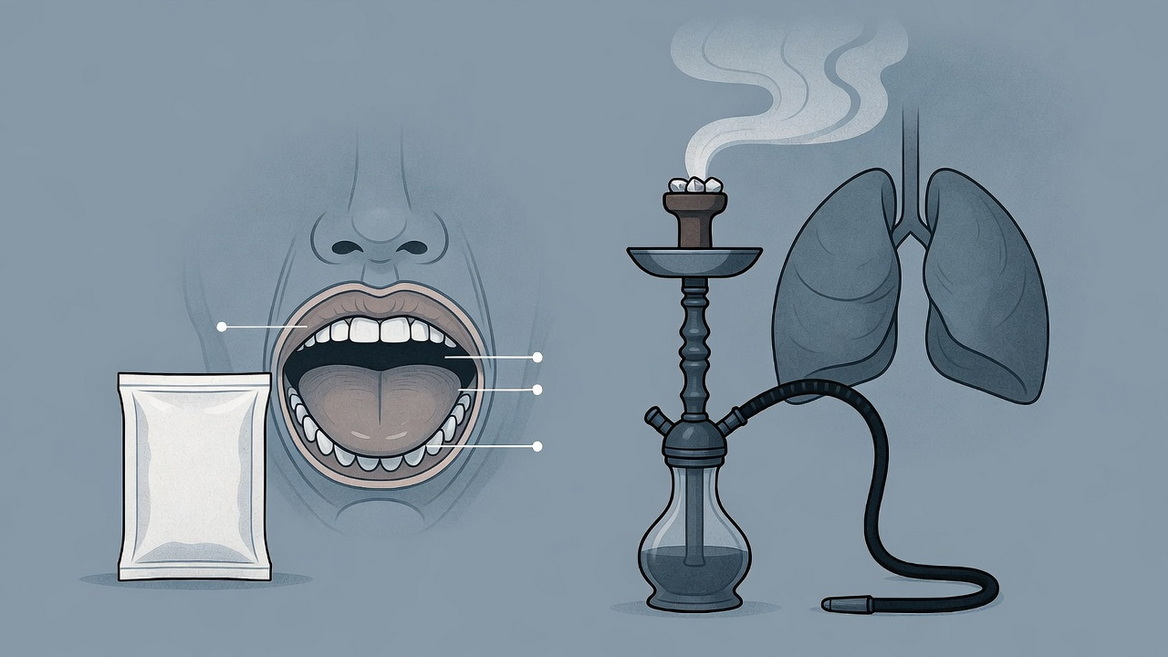
Nicotine pouches are small sachets containing nicotine and other ingredients, which may include flavorings and sweeteners. They sit between the lip and gum, where nicotine is absorbed through the mouth. Unlike snus, nicotine pouches generally do not contain tobacco leaf. However, "tobacco-free" does not mean nicotine-free or addiction-free. [cdc]
Fruit-flavored versions belong to this same product category. Their flavor descriptions do not change the underlying route of exposure or remove nicotine-related risks. The Australian Therapeutic Goods Administration, or TGA, warns that some products contain high nicotine levels and that labeling may be inaccurate. [tga.gov]
Hookah, also called waterpipe, is a device used to inhale smoke from a heated preparation. Traditional hookah tobacco is commonly called shisha. The U.S. Food and Drug Administration describes hookah tobacco as a product that produces smoke when heated in a hookah device. [fda]
The complete exposure involves more than the preparation itself. Charcoal used as a heat source can generate carbon monoxide and other harmful substances, while the resulting smoke passes through water before inhalation. Water does not remove the health hazards associated with that smoke. [fda]
"Hookah juice" is not a sufficiently precise description for a health comparison. Before interpreting the term, establish whether the writer means traditional shisha tobacco or a liquid intended for an electronic device.
This article focuses on traditional heated hookah preparations. Conclusions about their smoke should not automatically be transferred to an unidentified liquid or electronic product. The product category must be clear before its exposure profile can be discussed.
| Comparison point | Fruit nicotine pouches | Traditional hookah products |
|---|---|---|
| Exposure route | Nicotine absorption through the mouth. | Inhalation of smoke from a heated preparation. |
| Combustion-related exposure | No smoke generation during ordinary pouch use; nicotine-related risks remain. | Smoke can contain carbon monoxide, metals, and cancer-causing chemicals. |
| Tobacco leaf | Generally absent; nicotine may still be present at high levels. | Present in traditional hookah tobacco. |
| Equipment | Does not require a waterpipe or heat source. | Uses a hookah device and a heat source, often charcoal. |
| Exposure to others | Does not generate secondhand smoke during ordinary use. | Secondhand smoke exposes people nearby to harmful substances. |
| Main evidence limitation | Long-term health effects remain uncertain. | Health risks are established, but exposure varies with session characteristics. |
These differences do not create a universal safety ranking. A meaningful assessment must specify the health outcome, product composition, nicotine exposure, and pattern of use.
A label such as "apple" or "mixed berry" describes an intended flavor impression. It does not establish that two products have identical ingredients or produce an equivalent experience.
For editorial purposes, three separate questions are useful:
1. Do the products use similar flavor descriptions?
2. Do users perceive them as similar?
3. Do they produce comparable chemical exposure?
Answering the first question does not answer the other two. Without direct comparative evidence, claims such as "the same shisha experience" or "a complete hookah replacement" go beyond what the label demonstrates.
Pouches involve contact between a nicotine-containing mixture and oral tissues. Hookah use involves inhalation of smoke generated by heating a preparation. These are different physical processes, not simply different containers for the same experience. [cdc]
Consequently, "replicating shisha" should be treated as a subjective claim rather than a medical or technical finding. A credible comparison separates flavor expectations from statements about nicotine delivery and health.
It should also avoid presenting the absence of a large smoke setup as proof of safety. Eliminating equipment is a practical difference; eliminating health risk is a much stronger claim.
A product's stated nicotine content does not, by itself, establish how much nicotine enters the bloodstream. It is therefore inappropriate to translate a pouch label directly into an equivalent number of hookah sessions.
Label reliability is another concern. The TGA warns that nicotine pouch information may be inaccurate and that products can contain high or inconsistent nicotine levels. This limits the confidence readers should place in simple strength comparisons. [tga.gov]
The CDC reports that a single hookah session can expose a person to nearly nine times the carbon monoxide and 1.7 times the nicotine associated with one cigarette. These figures compare a session with a cigarette, not equal durations or identical patterns of use. [cdc]
That distinction is essential. The figures illustrate potentially substantial exposure, but they are not a conversion formula for every hookah session, every cigarette, or any nicotine pouch.
A responsible article should explain the comparison's basis rather than repeat a dramatic number without context.

Hookah smoke contains harmful substances, including carbon monoxide, heavy metals, and cancer-causing chemicals. The FDA links hookah use with serious health outcomes, including cancers and chronic obstructive pulmonary disease. Short-term effects can include increased heart rate, increased blood pressure, and reduced oxygen availability from carbon monoxide exposure. [fda]
Passing smoke through water does not make it safe. Water may change the sensation of the smoke, but it does not filter out the harmful chemicals sufficiently to remove the associated health risks. [fda]
Secondhand exposure also matters. Hookah smoke affects people nearby, not only the person using the device. [cdc]
Nicotine pouches do not create smoke during ordinary use, but nicotine is highly addictive. It poses particular risks during pregnancy and adolescence, including harm to the developing brain. [cdc]
The TGA states that the long-term health effects of nicotine pouches remain unknown. It also highlights concerns about high nicotine levels, inaccurate labeling, and potential contaminants. [tga.gov]
This uncertainty should not be filled with either reassurance or exaggeration. Evidence about traditional smokeless tobacco should not automatically be assigned to tobacco-leaf-free pouches, and an absence of long-term findings is not evidence that harm is absent.
People who do not currently use nicotine should not start using nicotine pouches. Young people and pregnant people face particular nicotine-related risks. Readers concerned about dependence or existing health conditions should seek individualized clinical advice rather than rely on flavor comparisons. [cdc]
"Smoke-free" describes the absence of smoke, not the absence of nicotine dependence or every other health concern.
A better comparison identifies the exposure that is absent and the risks that remain. For pouches, that means distinguishing lack of combustion from continued nicotine exposure and uncertain long-term effects. [cdc]
Not every pouch has the same nicotine content, and not every hookah session generates the same exposure. Product information and session-level findings should not be generalized beyond what the evidence supports. [tga.gov]
A trustworthy comparison states its limits instead of offering a precise-looking equivalence that the available evidence cannot justify.
Using another nicotine product is not automatically the same as stopping nicotine use. The TGA reports limited evidence that nicotine pouches support smoking cessation or help manage nicotine dependence. [tga.gov]
For someone seeking to quit, the appropriate comparison is not merely "pouch or hookah?" It is which evidence-based treatment and behavioral support are suitable for that individual. Australian health authorities identify approved nicotine replacement therapies and other clinically appropriate medicines as available options. [tga.gov]
As of October 19, 2026, Australian nicotine pouch rules are particularly important to this discussion.
The TGA states that, from July 24, 2026, consumers no longer have a lawful pathway to buy or import nicotine pouches in Australia. Retailers, including online sellers, cannot lawfully sell them. Medical practitioners cannot prescribe them, and pharmacies cannot make or supply them through the former access arrangements. [tga.gov]
The changes also closed personal importation and removed the traveler's exemption for nicotine pouches. The TGA states that imported pouches will be seized at the border and destroyed. [tga.gov]
These consumer restrictions should not be inaccurately paraphrased as a claim that every possible research or statutory pathway is prohibited. The TGA separately identifies research and other statutory exemptions. [tga.gov]
For consumers, however, an overseas website accepting an order does not establish lawful Australian access.
Before relying on a pouch-versus-hookah comparison, ask:
1. What exact products are being compared?
2. Does "tobacco-free" still involve nicotine?
3. Is the claim about flavor, exposure, disease risk, or quitting?
4. Does a quoted statistic compare equal units?
5. Are uncertainties stated clearly?
6. Is regulatory information current for the reader's location?
Be especially cautious when an article jumps from "no smoke" to "safe," or from "similar fruit flavor" to "equivalent experience."
For Australians seeking help with smoking or nicotine dependence, speak with a doctor or pharmacist or contact Quitline on 13 7848. The TGA identifies these as appropriate routes to evidence-based support. [tga.gov]

No. Nicotine pouches are oral products, while traditional shisha is a preparation heated in a hookah to produce inhaled smoke. Similar flavor descriptions do not make the products equivalent. [cdc]
No. Hookah smoke still contains harmful substances after passing through water. The FDA specifically warns that water does not filter the smoke clear of toxic chemicals. [fda]
No. "Tobacco-free" generally refers to the absence of tobacco leaf. Nicotine pouches can still contain substantial nicotine and cause dependence. [tga.gov]
Not on the evidence summarized by the TGA. It reports limited evidence supporting their use for smoking cessation or nicotine-dependence management. Approved treatment options should be discussed with a healthcare professional. [tga.gov]
No. From July 24, 2026, the personal importation pathway closed, including importation with a medical prescription. The TGA also states that nicotine pouches are no longer available for prescription supply. [tga.gov]
There is no universal conversion supported by these sources. Product nicotine content, label reliability, and session-specific exposure prevent a dependable one-to-one comparison. [tga.gov]
- Centers for Disease Control and Prevention. "Nicotine Pouches." January 31, 2025. Overview of oral nicotine products, dependence, and risks for vulnerable populations. [cdc]
- Centers for Disease Control and Prevention. "Hookahs." October 17, 2024. Overview of hookah smoke, toxicant exposure, and secondhand risks. [cdc]
- U.S. Food and Drug Administration. "Hookah Tobacco (Shisha or Waterpipe Tobacco)." May 21, 2026. Product definition, smoke constituents, and health effects. [fda]
- Mayo Clinic. "Hookah Smoking: Is It Safer Than Cigarette Smoking?" May 10, 2025. Medical explanation of water filtration and smoking-related risks. [mayoclinic]
- Therapeutic Goods Administration. "Nicotine Pouches." July 16, 2026. Australian consumer restrictions, product concerns, and regulatory pathways. [tga.gov]
- Therapeutic Goods Administration. "New Regulations Strengthen Controls on Nicotine Pouches." July 17, 2026. Regulatory changes and evidence-based cessation support. [tga.gov]
- MD Anderson Cancer Center. "What to Know About Nicotine Pouches." January 16, 2025. Clinical perspective on dependence and remaining uncertainties. [mdanderson]
This website contains products intended for adults only.
Are you 18 years of age or older?
WARNING: This product contains nicotine. Nicotine is an addictive chemical.


