
Language
Views: 249 Author: 7DaysVape Publish Time: 2026-10-16 Origin: Site


Content Menu
● Nicotine Pouch Tin vs Disposable Vapes: The Essential Differences
>> What Is a Nicotine Pouch Tin?
● Which Is More Cost-Effective for Commuters?
>> Compare Cost per Day, Not Cost per Package
>> Why "Cost per Puff" Can Mislead
● Australian Rules Change the Entire Comparison
>> Nicotine Pouches: No Current Consumer Purchase Pathway
>> Disposable Vapes: Not a Lawful Pharmacy Option
>> What This Means for a Budget Decision
● A Transparent Cost Model Without Invented Prices
>> Add Costs That Package Prices Hide
● Commuter Convenience: Practical Differences Without the Marketing Hype
>> Portability and Device Reliability
>> Public Transport and Workplace Restrictions
● Health Risks: Lower Price Does Not Mean Lower Risk
>> Both Formats Can Maintain Nicotine Dependence
>> Nicotine Pouches Have Important Evidence Gaps
>> Disposable Vapes Are Not Equivalent to Approved Treatment
● Environmental Costs and End-of-Life Responsibilities
● A Seven-Day Budget Audit for Adult Nicotine Users
● Conclusion: Make the Budget Decision Fit the Legal and Health Context
>> 1. Is a nicotine pouch tin cheaper than disposable vapes?
>> 2. Can Australian commuters legally order nicotine pouches online?
>> 3. Are disposable vapes available from Australian pharmacies?
>> 4. Does "tobacco-free" mean a nicotine pouch is safe?
>> 5. Can pouch strength be compared directly with vape nicotine concentration?
>> 6. What should a budget-conscious commuter do instead?
A nicotine pouch tin vs disposable vapes comparison should answer more than "Which costs less?" For budget-constrained commuters, the useful question is which option combines predictable spending, practical use, lawful access, and an informed understanding of health risks.
There is no universal price winner. A pouch tin offers a countable number of portions, while a disposable vape's useful lifespan depends on actual consumption and device performance. Neither format is risk-free.
For Australian readers, legality comes first. As of October 15, 2026, consumers have no lawful pathway to buy or import nicotine pouches in Australia. Disposable vapes are also unavailable through the lawful pharmacy supply system. Neither should therefore be presented as an Australian budget-shopping recommendation.
This guide compares the formats for adult readers, explains how to evaluate their real costs, and separates international product comparisons from Australia's current rules. It does not recommend starting nicotine use.
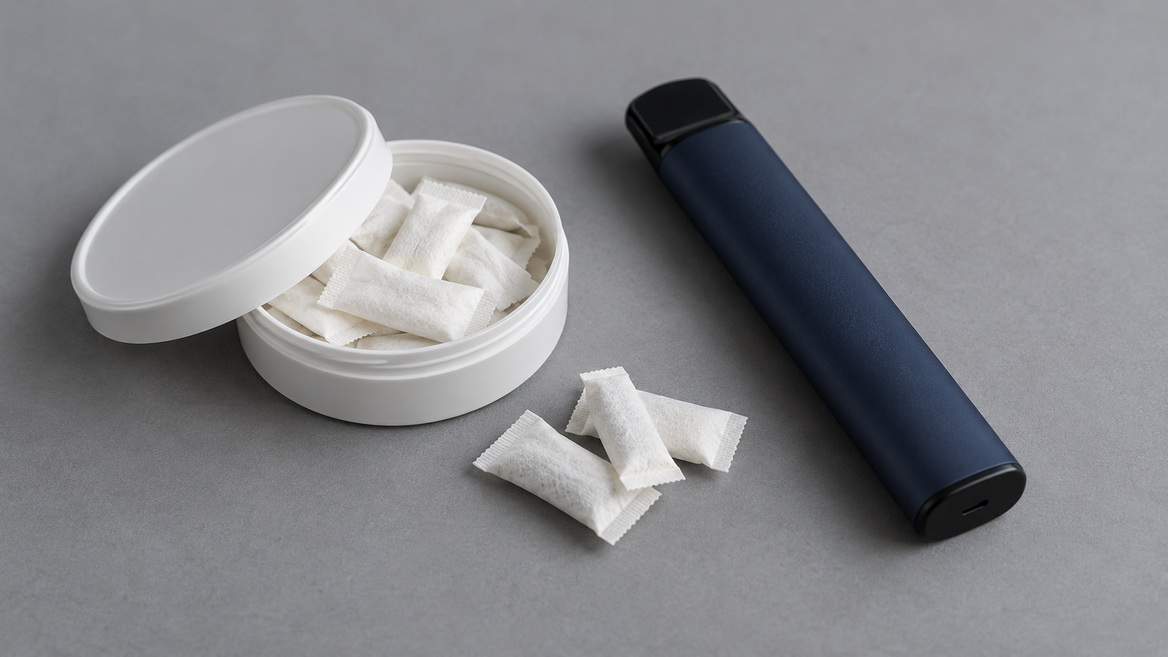
A nicotine pouch tin is a container holding small oral sachets. The container may be plastic rather than metal, despite the common term "tin."
Nicotine pouches generally contain nicotine, fillers, flavourings, and other ingredients. They sit between the lip and gum, where nicotine is absorbed through the mouth.
They do not require combustion, a heating coil, or inhalation. However, "tobacco-free" does not mean nicotine-free, harmless, or approved for quitting smoking.
Pouches are also distinct from snus, which contains tobacco. Treating the two as interchangeable creates confusion about ingredients and regulation.
A disposable vape is an electronic cigarette designed to be discarded rather than repeatedly refilled and maintained.
It heats e-liquid to produce an inhalable aerosol. Its main components include a battery, heating element, liquid reservoir, and mouthpiece.
Some products described internationally as disposable can recharge their batteries but cannot be refilled. A rechargeable battery alone does not make a device genuinely reusable.
Terms such as "vape," "e vape," and "electronic cigarettes" describe broader product categories. They should not be assumed to mean disposable devices.
| Factor | Nicotine pouch tin | Disposable vape |
|---|---|---|
| Delivery route | Absorption through the mouth | Inhalation of aerosol |
| What the package contains | Individual sachets | Battery, heating element, and e-liquid |
| Basic cost measure | Cost per pouch and per day | Cost per device and per day |
| Quantity visibility | Remaining pouches can be counted | Remaining usable life can be less obvious |
| Battery dependence | None | Required |
| Waste considerations | Used sachets and packaging | Electronic components, battery, and residual liquid |
| Health limitation | Addiction risk; long-term effects remain uncertain | Addiction risk where nicotine is present; aerosol exposure |
| Australian consumer access | No lawful buying or import pathway | Disposable vapes are not available through lawful pharmacy supply |
The most defensible answer is that cost-effectiveness depends on actual daily spending—not package size, advertised puff counts, or perceived strength.
A pouch tin may make consumption easier to count. A disposable vape may have a low initial price in some international markets. Neither observation proves that the product will cost less over a month.
From a budgeting perspective, I would start with receipts and replacement dates rather than promotional specifications. That approach avoids comparing a measurable pouch count with an uncertain device lifespan.
Use these calculations:
- Pouch cost per day = tin price ÷ pouches per tin × pouches used daily.
- Vape cost per day = device price ÷ actual days of usable life.
- Monthly cost = average daily cost × days in the month.
Then add delivery charges and other unavoidable expenses.
Record total use, not only use during the commute. Evening and weekend consumption still affects the household budget.
A puff is not a standardised dose.
Puff duration, frequency, device settings, and product design influence consumption. An advertised puff count should not be treated as a guarantee of how many commuting days a device will last.
Similarly, one pouch is not equivalent to a fixed number of vape puffs. The formats deliver nicotine differently, and labelled nicotine content does not establish equal absorption.
The useful financial comparison is observed daily expenditure. It is not a homemade nicotine-equivalence calculation.
For 7DaysVape's Australian audience, international availability must not be confused with lawful local access.
From July 24, 2026, consumers can no longer lawfully buy or import nicotine pouches in Australia.
The changes removed access through personal importation, relevant unapproved-medicine prescribing pathways, and pharmacist compounding. A prescription does not restore the former personal-import route.
Travellers also cannot rely on the previous traveller's exemption to bring nicotine pouches into Australia.
An overseas checkout accepting an Australian address does not demonstrate that the transaction is lawful.
Australia's lawful vaping supply system is pharmacy-based and intended to support smoking cessation or nicotine-dependence management.
Single-use disposable vapes cannot be purchased through that system. Ordinary vape shops, convenience stores, and other non-pharmacy retailers cannot lawfully sell vaping products.
Eligible adults may access certain therapeutic vapes through participating pharmacies following pharmacist consultation, subject to state and territory requirements.
For adults, products containing more than 20 mg/mL nicotine require a prescription. Access without a prescription to lower-concentration products is conditional, not unrestricted.
For an Australian commuter, neither product in this headline is a lawful retail alternative.
That distinction outweighs a hypothetical saving. A price comparison that ignores it would answer the wrong question.
The appropriate local comparison is between lawful, clinically suitable options for managing dependence, including approved nicotine replacement therapies and other cessation treatments.
Current prices vary by country, retailer, taxes, pack size, and delivery charges. Without verified local prices and consumption records, declaring one format "the cheapest" would be speculation.
A simple normalised model shows why usage matters.
The following figures are arbitrary currency units, not market prices, Australian offers, or suggested consumption levels.
| Hypothetical input | Pouch scenario | Disposable scenario |
|---|---|---|
| Package price | 10 units | 15 units |
| Package quantity or observed lifespan | 20 pouches | 5 days |
| Illustrative daily consumption | 4 pouches | One device every 5 days |
| Daily expenditure | 2 units | 3 units |
| Expenditure over 30 days | 60 units | 90 units |
Under these assumptions, the pouch scenario costs less.
But change the observed vape lifespan to 10 days and its monthly expenditure becomes 45 units. Change pouch consumption to eight daily and the pouch scenario becomes 120 units monthly.
These examples demonstrate sensitivity to consumption. They do not establish a product recommendation or equivalent nicotine exposure.
Include:
- Delivery and minimum-order charges.
- Products discarded before being fully used.
- Devices that stop working earlier than expected.
- Additional purchases outside the original budget.
- Time spent arranging compliant disposal.
For unlawful imports, a quoted price does not represent a dependable supply cost. Australian authorities state that imported nicotine pouches will be seized and destroyed.
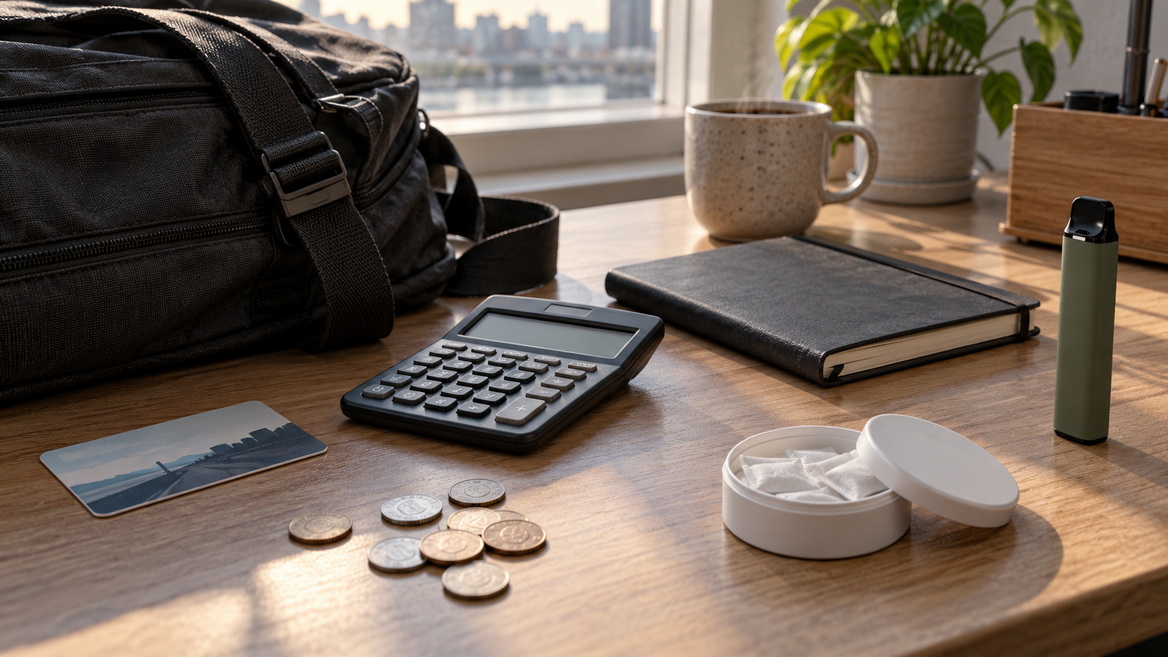
Pouches do not need a battery, charging cable, or heating element. Their remaining quantity is directly countable.
A disposable vape depends on its battery and heating system functioning. Its remaining useful life may not be apparent unless the device provides reliable information.
These are format differences, not proof that every pouch product is reliable or every disposable device is unreliable.
For someone tracking expenditure, countable portions can simplify recordkeeping. For either format, actual purchasing patterns remain more informative than appearance or packaging.
A product's physical ability to function indoors does not establish permission to use it.
Transport operators, employers, and venues may apply their own rules. Those rules also differ between jurisdictions.
Oral use does not create vaping aerosol, but that does not automatically make nicotine pouches acceptable in every workplace or lawful in every country.
Check the relevant policy rather than assuming that a less visible product is permitted. Do not use a product's discreet appearance as a reason to conceal prohibited use.
Both formats require responsible storage away from children and pets.
Nicotine pouches may lack adequate child-resistant packaging. Vape liquids and discarded devices can also contain nicotine.
For commuters carrying bags into homes, offices, and shared vehicles, secure storage matters more than convenience claims. Neither product should be left loose where another person could access it.
Nicotine is addictive. Changing its delivery format does not automatically reduce dependence.
Pouch strength, frequency of use, and vape consumption can all affect exposure. Package labels alone are insufficient to compare the nicotine actually absorbed.
People who do not currently use nicotine should not start because one format appears inexpensive or convenient.
Pregnant people, younger people, and people with relevant medical conditions need individual professional advice rather than a retail comparison.
Pouches avoid inhaling a heated aerosol. That is a meaningful distinction, but it is not evidence of harmlessness.
Australian authorities identify potential concerns including inconsistent nicotine content, contaminants, nausea, mouth lesions, dental damage, and nicotine-related cardiovascular effects.
Their long-term health effects remain uncertain. Evidence supporting nicotine pouches as smoking-cessation treatments is limited.
Commercial availability in another country should not be interpreted as medical approval.
Disposable electronic cigarettes should not be grouped automatically with regulated therapeutic products.
Australia's pharmacy framework includes product requirements and professional assessment. An overseas retail disposable does not acquire those safeguards simply because it contains nicotine.
Nicotine pouches are also not approved by the United States Food and Drug Administration as smoking-cessation aids.
For someone trying to stop smoking or vaping, treatment evidence matters more than product-category popularity.
Disposable vapes create a waste stream involving electronics, batteries, and potentially residual nicotine-containing liquid.
Lithium-ion batteries should not enter ordinary household rubbish or municipal recycling bins. They can cause fires when damaged during collection and processing.
Contact an appropriate local waste or hazardous-waste service for disposal instructions. Do not dismantle a device merely to improvise a recycling solution.
Pouches avoid electronic components, but still create used sachets and packaging waste. Do not assume that a container is recyclable without checking its material and local acceptance rules.
Neither format can be declared environmentally superior without a suitable lifecycle assessment. "Battery-free" and "waste-free" are not synonyms.
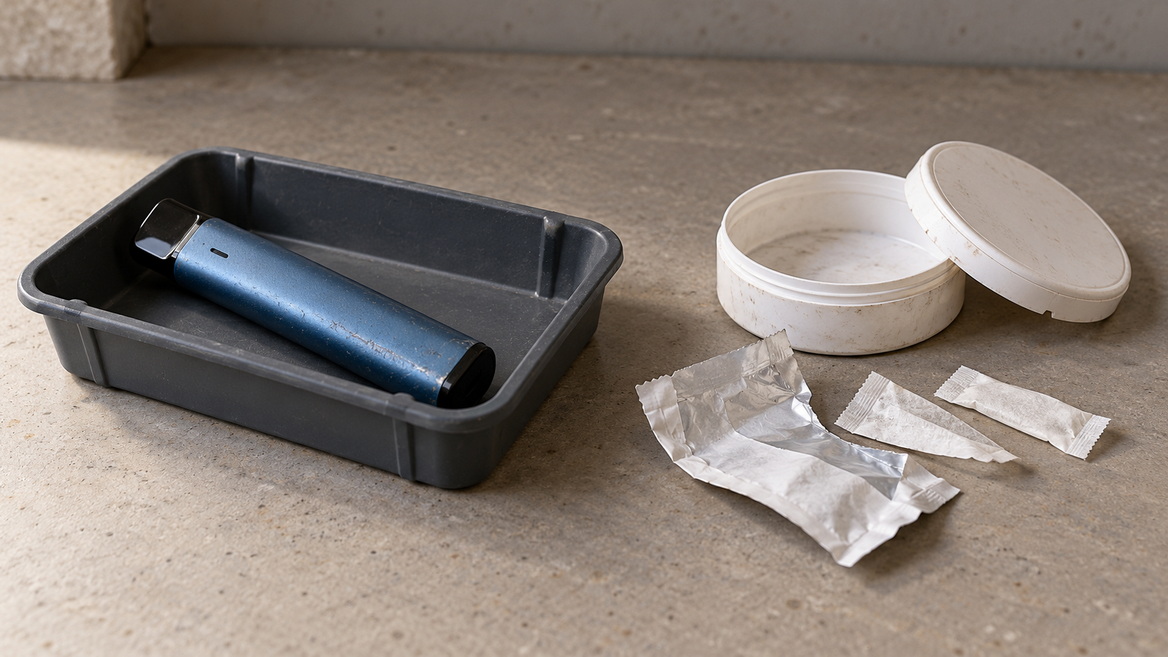
A short spending audit provides a more useful starting point than selecting a "winner" from advertising.
1. Record all nicotine-related purchases, including delivery charges.
2. Track actual consumption without increasing use for the exercise.
3. Note replacement dates and products discarded early.
4. Separate commuting use from home and weekend use.
5. Calculate total weekly expenditure.
6. Check whether every product and supply route is lawful locally.
7. Discuss dependence-management options with a pharmacist or clinician.
Do not buy either format merely to run a comparison.
If reducing spending is the goal, ask about an appropriate cessation plan, available subsidies, and behavioural support. The aim should be reducing dependence-related expenditure, not simply making continued use cheaper.
A nicotine pouch tin vs disposable vapes comparison has no universal cost winner. Actual consumption determines expenditure, while health evidence and lawful access determine whether a price comparison is meaningful.
For Australian commuters, neither format is a lawful shopping alternative. The practical next step is to review your weekly spending with a pharmacist or clinician and build a locally compliant plan for managing or reducing nicotine dependence.
Not necessarily. Tin price, pouch count, daily consumption, device price, and observed device lifespan determine the result. Compare actual daily spending rather than package prices alone.
No. As of October 15, 2026, consumers have no lawful pathway to buy or import nicotine pouches in Australia. Online sellers accepting orders do not establish lawful access.
No. Single-use disposable vapes cannot be purchased through Australia's lawful pharmacy system. Eligible patients may access appropriate therapeutic vaping products under the applicable conditions instead.
No. A product can contain no tobacco leaf while still delivering addictive nicotine. Pouches also have potential adverse effects, and their long-term health effects remain uncertain.
No. Milligrams per pouch and milligrams per millilitre measure different things. Neither figure alone tells you how much nicotine a person absorbs or establishes equivalent use.
Start with a spending record and professional advice. In Australia, ask a pharmacist or clinician about approved nicotine replacement therapies, other suitable cessation medicines, behavioural support, and possible subsidies.
1. Therapeutic Goods Administration. "Nicotine pouches." Published July 17, 2026. Covers product characteristics, health uncertainties, restrictions effective July 24, 2026, unlawful advertising and supply, importation, and cessation support. [tga.gov]
2. Australian Government Department of Health, Disability and Ageing. "Vaping laws." Updated April 16, 2026. Explains pharmacy-only supply, pharmacist assessment, prescription thresholds, flavour restrictions, and state and territory conditions. [health.gov]
3. Australian Government Department of Health, Disability and Ageing. "About vaping and e-cigarettes." Explains Australia's vaping framework and confirms that single-use disposable vapes cannot be purchased in pharmacies. [health.gov]
4. United States Centers for Disease Control and Prevention. "Nicotine Pouches." Published January 31, 2025. Provides public-health information and clarifies that nicotine pouches are not approved smoking-cessation aids. [cdc]
5. United States Environmental Protection Agency. "Used Lithium-Ion Batteries." Provides consumer guidance on separate battery collection, electronic-device disposal, and avoiding household rubbish and municipal recycling bins. [epa]
6. United States Environmental Protection Agency. "How to Safely Dispose of E-Cigarettes: Information for Schools and Small Businesses." Updated December 27, 2024. Explains hazards associated with residual nicotine and lithium batteries; its institutional disposal procedures are specific to its stated audience. [epa]
7. United States Food and Drug Administration. "Want to Quit Smoking? FDA-Approved and FDA-Cleared Cessation Products Can Help." Explains approved cessation options, including nicotine patches, gum, lozenges, and prescription medicines. [fda]
This website contains products intended for adults only.
Are you 18 years of age or older?
WARNING: This product contains nicotine. Nicotine is an addictive chemical.


