
Language
Views: 216 Author: 7DaysVape Publish Time: 2026-11-03 Origin: Site


Content Menu
● What Is a Rechargeable Vape?
● Different Types of Rechargeable Vapes
>> Vape Mods and Tank-Based Devices
>> Rechargeable Disposable Vapes
● What Rechargeability Does Not Tell You
● Rechargeable Vape Battery Safety
>> A Basic Charging Safety Checklist
>> Removable Batteries Require Additional Care
● When Charging Problems Need More Than Another Cable
● Australian Rules: Why Overseas Vape Advice Can Mislead
>> Prescription Requirements Are Conditional
>> Compliance Is Not the Same as Product Approval
● How to Assess Product Claims and User Reviews
● Sustainability Claims Need More Than a Rechargeable Battery
>> Are rechargeable vapes always refillable?
>> Is a rechargeable disposable vape reusable?
>> Can any USB charger be used?
>> Does recharging fix a burnt taste or an empty reservoir?
>> Can Australians order vapes from overseas websites?
>> Are nicotine-free vapes exempt from Australian retail restrictions?
>> Does a rechargeable vape have no health risks?
Rechargeable vapes are electronic cigarettes with batteries designed to accept another charge. That description sounds straightforward, but it leaves several important questions unanswered. Can the device be refilled? Can its battery be replaced? Is the whole product disposable once the e-liquid runs out? And can it legally be supplied where the reader lives?
Understanding these distinctions matters more than product labels. Terms such as vape pen, pod system, e vape, and rechargeable disposable vape describe different aspects of a device, not a single consistent classification.
This guide explains those differences, outlines essential battery precautions, and addresses the rules that make Australian access different from ordinary online retail. It is educational information, not a product recommendation or medical advice.

A rechargeable vape uses electrical energy stored in a battery to heat e-liquid and produce an aerosol that the user inhales. Recharging restores the battery's stored energy; it does not replenish liquid, repair a worn component, or make a product safe.
The most important distinction is rechargeable versus refillable.
A device may have a rechargeable battery but a sealed liquid reservoir. Another may allow liquid refilling while using a battery that cannot be removed. A third may combine a rechargeable power unit with replaceable, prefilled pods.
These features need to be checked separately.
| Term | What it describes | What it does not establish |
|---|---|---|
| Rechargeable | The battery can accept another charge | Whether the liquid reservoir is refillable |
| Refillable | The reservoir is designed for additional liquid | Whether the battery is replaceable |
| Replaceable pod | A cartridge can be exchanged | Whether that cartridge can be refilled |
| Replaceable battery | The specified battery can be removed and exchanged | Compatibility with other batteries |
| Disposable | The product is intended for disposal after its usable contents or service life end | Whether it includes a charging port |
A charging connection alone therefore says little about a device's overall lifespan.
Device categories overlap. A pen-shaped product can use a tank or a pod, while a pod-based device can contain either a refillable or sealed cartridge.
A clearer explanation separates physical format from component design.
"Vape pen" generally describes a relatively narrow device format. It is not a technical guarantee about battery capacity, nicotine content, liquid compatibility, or maintenance requirements.
Some pen-style products include refillable reservoirs. Others use replaceable cartridges. Their outward similarity does not mean their components are interchangeable.
Descriptions such as "simple" or "beginner-friendly" also require context. A small device still contains a battery, heating components, and potentially nicotine-containing liquid.
Pod systems combine a powered device with a cartridge containing e-liquid or designed to hold it.
Two distinctions are especially useful:
- A prefilled pod contains liquid supplied in the cartridge.
- A refillable pod is specifically designed to accept additional liquid.
Some pods incorporate their heating component. Other designs use separately replaceable parts. Instructions for one system should not be assumed to apply to another.
A sealed pod should not be treated as refillable merely because someone demonstrates opening it online.
The term "mod" commonly refers to a power unit associated with a separate tank and, in some cases, adjustable settings.
The tank holds liquid and associated heating components. It is not itself the rechargeable battery.
This distinction corrects a common source of confusion: "rechargeable tank" is usually an imprecise description of a tank connected to a rechargeable power unit.
Adjustable controls introduce additional compatibility questions. More settings do not establish better safety, and components should not be combined solely because they appear to fit.
A rechargeable disposable vape contains a battery that can be recharged during the product's intended service life, while the device remains disposable overall.
Recharging does not necessarily make the reservoir refillable or the heating component replaceable.
This category demonstrates why "rechargeable" and "reusable" should not be treated as synonyms. A product can accept several charges yet still become waste when its sealed liquid supply is exhausted.
Its availability also depends on local law. A description used by an overseas retailer does not establish that the product can legally be supplied in Australia.
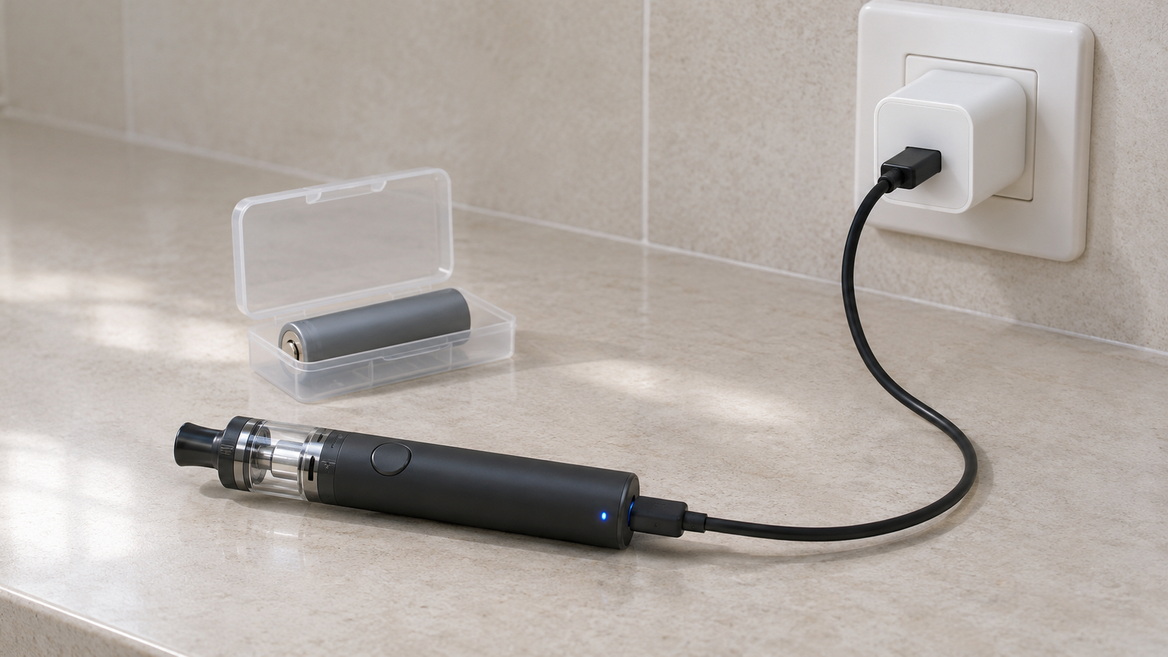
A charging port is a feature, not a quality assessment.
It does not independently establish:
- Product authenticity.
- Compliance with applicable standards.
- Battery condition.
- Accurate nicotine labelling.
- Compatibility with a particular power adapter.
- A predictable number of uses.
- Reduced health risk.
This is particularly important when reading broad claims about performance or sustainability.
A larger advertised battery capacity does not, by itself, establish how long a device will operate. Likewise, a stated puff count is not enough to establish a reliable service interval without a clear explanation of testing conditions.
The practical question is not simply, "Does it recharge?" It is, "What exactly has been documented, and by whom?"
Battery safety deserves its own section rather than a brief note beneath product descriptions.
The U.S. Food and Drug Administration warns that vape batteries can cause fires or explosions. Although such incidents appear uncommon, the potential injuries can be serious.
Manufacturer instructions are essential because charging arrangements and battery requirements differ between devices.
For a device already in use:
1. Read the manufacturer's instructions before charging.
2. Use the charging equipment specified for that device.
3. Charge on a clean, flat surface away from readily combustible materials.
4. Keep the device visible rather than covering it with bedding or cushions.
5. Do not leave it charging overnight or unattended.
6. Avoid charging in extreme temperatures.
7. Keep the device away from flammable gases and liquids.
Do not assume that every adapter is suitable because its cable fits the port. Physical connection and electrical suitability are different questions.
Where a device uses removable batteries, follow its exact battery specifications.
Do not mix old and new batteries, different brands, or batteries with different charge levels. Loose batteries should be protected from contact with keys, coins, and other metal objects.
Damaged or wet batteries should not remain in service. If a device is damaged and its battery is not replaceable, contact the manufacturer rather than opening the housing.
These precautions do not eliminate every risk. They establish a safer handling baseline, not a guarantee against failure.
A device that stops charging does not automatically have a cable problem.
An empty liquid reservoir, a worn heating component, a damaged battery, and a charging fault are different issues. Repeatedly reconnecting a device does not identify which one is present.
Use the documentation to distinguish ordinary status indicators from fault warnings. If the meaning is unclear, contact the manufacturer.
Avoid online "repair" suggestions involving:
- Opening sealed battery compartments.
- Bypassing protective circuitry.
- Connecting exposed wires to a battery.
- Substituting an unspecified battery.
- Forcing a sealed reservoir open.
A useful troubleshooting guide should explain when to stop, not merely list ways to make a device operate again.
Australian readers need a jurisdiction-specific explanation.
The Therapeutic Goods Administration states that therapeutic vapes for smoking cessation and management of nicotine dependence are available through participating pharmacies where clinically appropriate.
Other retailers cannot sell vapes to consumers, regardless of whether the products contain nicotine. The TGA also states that consumers cannot purchase vapes from overseas retailers or websites for personal use.
These restrictions mean that a foreign product guide may describe devices without providing a lawful access pathway for an Australian reader.
Under the pharmacist model, adults aged 18 or over may be able to access therapeutic vapes containing 20 mg/mL of nicotine or less without a prescription.
This is subject to conditions, including pharmacist assessment and relevant state or territory requirements. It is not unrestricted retail access.
Products containing more than 20 mg/mL require a prescription. Different requirements also apply to younger patients.
A pharmacist is not obliged to supply a vape merely because a person requests one.
Regulatory language needs careful treatment.
The TGA maintains information about therapeutic vaping goods notified as complying with applicable standards. That status should not be rewritten as a blanket claim that every listed product has undergone a full individual assessment of safety and effectiveness.
Readers should distinguish between a product's regulatory status, the conditions under which it can be supplied, and evidence supporting any health-related claim.
These are related questions, but they are not interchangeable.

Personal accounts can identify questions worth investigating. They do not replace technical documentation or clinical evidence.
A review saying "the battery lasts all day" lacks important context unless it explains usage, device condition, and testing conditions. A statement such as "this helped me quit" describes an individual experience, not a result that can be promised to someone else.
When reviewing claims, ask:
- Is the writer describing direct experience?
- Is the specific device clearly identified?
- Are observations separated from assumptions?
- Is the relationship with the supplier disclosed?
- Are health claims supported beyond a testimonial?
- Does the information apply to the reader's country?
The same standard applies to editorial writing. An author should not claim hands-on testing without test records or present a promotional title as proof of technical expertise.
Rechargeability describes how energy is restored. It does not measure a product's complete environmental impact.
A meaningful comparison would need to consider the whole device, including its service life, replacement components, materials, and eventual waste handling.
For example, a sealed rechargeable disposable product still becomes waste after its intended service life. A longer-lasting device may also generate discarded pods, heating components, packaging, or batteries.
Without a defined comparison and supporting evidence, phrases such as "eco-friendly" or "the sustainable choice" are too broad.
A more accurate description identifies the specific feature—such as a rechargeable battery—without converting it into an unsupported environmental conclusion.
No. Rechargeability describes the battery. Refillability describes the liquid reservoir. A sealed disposable vape can have a rechargeable battery without being designed for refilling.
Only in a limited sense. Its battery may accept additional charges during its intended lifespan, but its sealed liquid reservoir or other components may still determine when the whole product becomes waste.
Do not assume so. Follow the device manufacturer's charging instructions and use the specified equipment. A cable fitting into a port does not establish that the charging arrangement is appropriate.
No. Restoring battery energy does not replenish e-liquid or repair a worn heating component. Follow the manufacturer's instructions rather than repeatedly charging a device to address an unrelated problem.
The TGA states that vapes cannot be purchased from overseas retailers or websites for personal use. Australian therapeutic access operates through participating pharmacies under applicable conditions.
No. The TGA states that restrictions on non-pharmacy retail supply apply regardless of whether a vape contains nicotine.
No. Rechargeability does not remove exposure risks or battery hazards. Nicotine-containing products can cause dependence, and vaping should not be described as harmless.
1. VaporFi. *Guide to Different Rechargeable Vapes.* Last updated February 19, 2025. Original article reviewed for its terminology, structure, and claims—not treated as independent medical evidence. [Original article]. [vaporfi]
2. U.S. Food and Drug Administration. *Tips to Help Avoid Vape Battery Fires or Explosions.* Guidance on charging, battery compatibility, temperature exposure, and fire hazards. [Read the guidance]. [fda]
3. U.S. Food and Drug Administration. *5 Tips to Help Avoid "Vape" Battery Explosions.* Safety information covering charging supervision, charging equipment, loose batteries, and damaged devices. [Read the safety document]. [fda]
4. Therapeutic Goods Administration. *Vapes: Information for Individuals and Patients.* Australian access pathways, overseas purchasing restrictions, and prescription conditions. [Read patient information]. [tga.gov]
5. Therapeutic Goods Administration. *Vapes: Information for Pharmacists.* Pharmacy supply conditions and applicable nicotine concentration requirements. [Read pharmacist guidance]. [tga.gov]
6. Therapeutic Goods Administration. *Vapes: Compliance and Enforcement.* Information about personal importation, lawful supply, and notified therapeutic products. [Read compliance guidance]. [tga.gov]
7. U.S. Food and Drug Administration. *E-Cigarettes, Vapes, and Other Electronic Nicotine Delivery Systems.* Overview of product categories and health and safety risks. [Read the overview]. [fda]
This website contains products intended for adults only.
Are you 18 years of age or older?
WARNING: This product contains nicotine. Nicotine is an addictive chemical.


